Archive for the ‘Hiking’ Category

Sobaeksan hiking, Wednesday 19th December 2012

January 15, 2013

OLYMPUS DIGITAL CAMERA

I don’t have much of an interest in Korean politics other than, as with everywhere else,  the general wish that the left will do better than the right. What I do have an interest in though is getting a day off work for the day of the Presidential election. As I don’t have a vote, it leaves me free to spend the day doing something else.

Jen and I had planned on hiking in Sobaeksan National Park last summer, but once we got there it turned out to be too hot and we settled for a wander around the caves instead. Winter is better for hiking though, or at least it is for me and so I thought we could give it another go.

I nipped out of work early the evening before and we caught the 7.10pm mugungwha train from Cheongnyangi to Danyang. Cheongnyangi is a station that took me a while to discover. Previously I’d only been checking options from the main stations of Seoul and Yongsan, but leaving from the smaller Cheongnyangi terminus meant that we could get to Danyang on the Tuesday evening and then get an early start the next day. The journey takes around an hour and a quarter and costs about eleven thousand won.

It didn’t look as if there were any hotels near the out-of-town Danyang railway station and so we took a taxi into town and found a room in a hotel across the road from the bus terminal. It was the same place that we’d stayed at in the summer, although I think they charged more than thirty thousand won last time we were there.

OLYMPUS DIGITAL CAMERA

It didn’t quite work out as planned the next morning as, possibly due to the previous night’s wine consumption, the early start turned into a late one. It was already mid-morning when we got into a taxi. The driver suggested that we should go to the Eoulgok park entrance and we took his advice. He dropped us off twenty minutes later with a warning that we should hike quickly in order to be able to complete the route before dark.

Sobaeksan map

Sobaeksan map

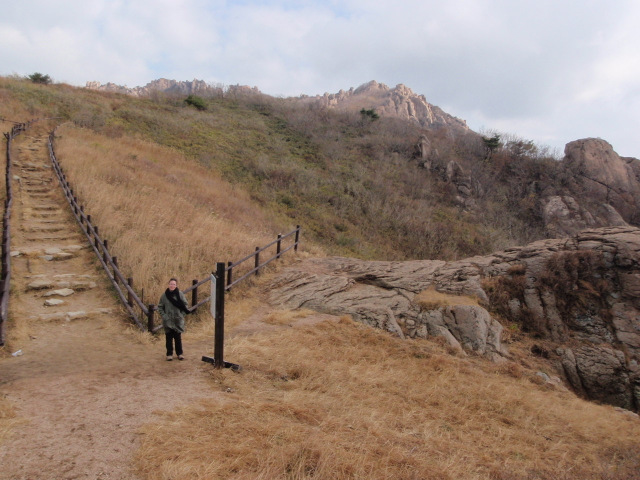
Our intention had been to hike up to the 1439m Birobong peak. It’s only 5.1km each way but has an estimated hiking time of six hours. The route starts at around 400m in height and looks to have a fairly even gradient gaining a couple of hundred metres in altitude every kilometre. It was hard going in places with a mixture of fresh snow and old ice and without spikes it wouldn’t have been possible to have got beyond the first twenty yards.

It's all forest tracks.

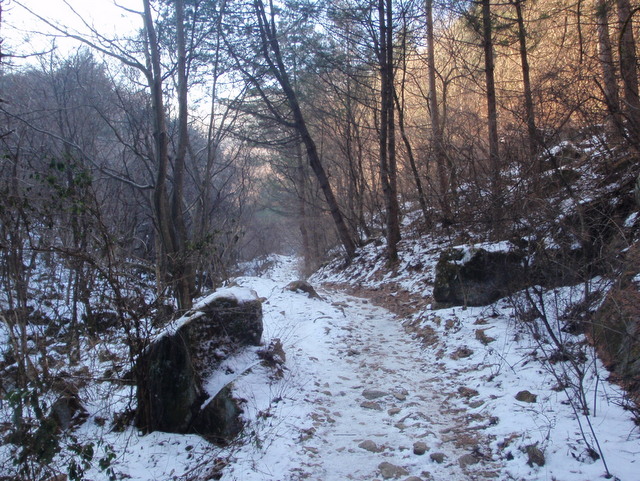
It’s all forest tracks.

We didn’t see too many other people all morning, possibly because they will have set out much earlier than we did. There were some impressive sections of frozen river though and in the places where the water was still running ice resembling jellyfish had formed around the stones that broke the surface.

Two hours in, we’d hiked 2.5 kilometres and got up to 940m. With another 2.6km still to do and another 500m of ascent it became apparent that we weren’t going to reach the top. Jen’s feet and legs were just about numb with the cold and I was feeling the effects of the previous night’s over-indulgence. It wasn’t a difficult decision to call it a day and head back down.

We made the reverse journey in an hour and a half and were fortunate enough to see a bus waiting at the bottom.

For the bus afficionados.

For the bus aficionados.

I don’t know how often the buses run to Danyang but it seemed a rare enough occurence for kids to stare and wave as it drove past. Everyone on it, bar us, seemed to know each other and each new arrival was given a cheery welcome as they got on.

Despite not getting to the top it was still a decent day out, three and a half hours in the hills beats a day sat at my desk every time. It’s a pity that the elections only take place every five years.

Deogyusan hiking, Saturday 1st December 2012.

December 18, 2012

OLYMPUS DIGITAL CAMERA

Deogyusan isn’t one of the furthest National Parks from Seoul but it’s one of the more awkward places to get to on public transport. As the short winter days don’t leave much time for hiking we thought that we’d  do a couple of hours worth of travelling on the Friday night to give us that bit more time the following day.

We caught the train at Seoul, changed at Daejeon and then got off at Yeongdong. It was after ten in the evening when we arrived and I suppose it’s a bit of a gamble in a small town when you are looking for somewhere to sleep at that time of night.

The first place we tried had rooms, but only for that night and we wanted somewhere for the Saturday as well. We moved further away from the station and tried the Dubai Motel. There can’t have been too many billionaire oil sheiks in town that weekend as we were able to pick up a room for forty thousand won a night. It was clean and smart, but let down slightly by the room being as hot as the Middle East and the bed being just as hard as the floor.

Dubai Motel, viewed from the station.

Dubai Motel, viewed from Yeongdong station.

The next morning we had to get ourselves firstly to Muju Bus Terminal and then on to the Gucheondong entrance to the park. It all worked out very well. If you come out of the railway station, turn right and then walk for about three hundred yards there’s a bus stop on the same side of the road. You can catch a bus to Muju for 1,150 won. They don’t run that often, I think ours left at 8.30am and the next one may very well have been after ten o’clock.

This is the bus stop you want.

This is the bus stop you want.

It took us forty minutes to get to Muju Bus Terminal and from there we caught a bus to Gucheondong. The buses seem to come and go every hour or so, they take thirty minutes and cost 3,900 won.

With very little time spent hanging about we were at the Gucheondong entrance by about ten o’clock. There weren’t many people around although I think that may have been down to the time of year. We were a bit late for the leaves changing colour and maybe slightly early for the main ski season. Whilst there were a few hotels I suspect that a lot of the year they will fill up fairly quickly.

Most of the restaurants seemed to specialise in trout. The ones swimming about in the tanks outside looked too large to be wild, so were probably pellet-fed farmed fish. Shame really, as a genuine wild trout takes some beating.

There were three options for going up to the 1,614m Hyangjeong peak. We discounted the route via Chilbong as that would have brought us out at the ski lift and if anywhere was going to be busy then that was it.

Deogyusan National Park map.

Deogyusan National Park map.

The other two alternatives both went via Baekyeonsa temple. One of them looped around via the 1,594m Jungbong and the other was a more direct but steeper route. We would probably have taken the longer circuit but unfortunately it was closed and so we didn’t have any choice in the matter. There was an excellent sign that not only showed the route and distance but also the gradient along the way.

Every hike should have information like this.

Every hike should have information like this.

The route seemed like two separate hikes. Initially we had a six kilometer walk up to the Baekyeonsa temple that followed the river most of the way. With the temperatures having been below freezing earlier in the week there was a lot of ice on the trail. We only gained four hundred metres in altitude over that section though and whilst it was often slippy underfoot it didn’t take too much out of us.

Baekyeonsa temple

Baekyeonsa temple

The next section was a different matter with a height gain of six hundred metres over 3.7km. The increased altitude meant a lot of compacted snow on the ground, whilst the increase in gradient resulted in a few staircases and other sections where we had to haul ourselves up using railings. There weren’t many people heading upwards but there were plenty who had taken advantage of the ski lift making their way down.

As we approached the summit we could see a shelter to our left. For those who like to see the sunrise from the top of a hill it would be an ideal place to spend the night.

Deogyusan shelter.

Deogyusan shelter.

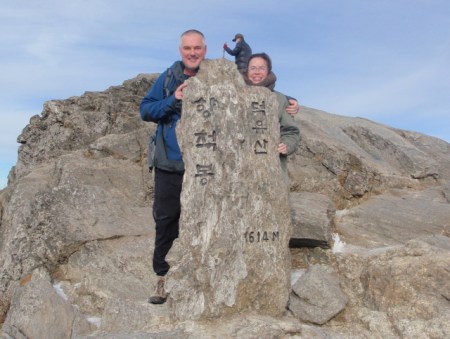
Three and three-quarter hours after setting off we reached the 1,614m Hyangjeokbong summit. It was fairly busy up there, but when you’ve got a ski-lift carrying people most of the way up that’s to be expected I suppose.

At the top.

At the top.

The views were fantastic. We were above the treeline and with barely a cloud in sight we could see for miles. In one direction there were eight or nine ridges stacked up into the distance.

That's a view.

That’s a view.

It was pretty cold up there and so we didn’t hang about too long. It’s a steep drop down to the ski-lift three or four hundred metres away at Seolcheong. As we passed the people coming up from the lift we could hear a lot of them complaining about the effort they were having to put in to walk that final stretch. Ungrateful wretches.

The ride down to the bottom cost eight thousand won and took twenty minutes. The resort had just opened for the season that weekend and only one of the slopes was in use. Artificial snow was being sprayed onto the others. The place was busy though, mainly with boarders rather than skiers, and as you can imagine they were all togged up in their best gear.

I think that's the baby slope.

I think that’s the baby slope.

We warmed up with some drinks, my selection of honey and pine needle tea tasting exactly like I imagine bathroom cleaner would do. We could have hung around for a free shuttle bus back to Muju but couldn’t be bothered to wait in the cold for it. Instead we caught a taxi and then when faced with a lengthy wait at the bus station we took another cab back to Yeongdong.

I reckon we did this walk at a decent time of year. With the leaves having fallen we were able to see through the trees on the way up, whilst there wasn’t that much snow as to make walking difficult. I imagine it will be spectacular later in the year when the river freezes.

Wolchulsan hiking, Saturday 17th November 2012

November 27, 2012

This time of year is about as good as it gets in Korea for hiking and so Jen and I decided to head south for the weekend and go for a walk in Wolchulsan National Park. We caught the KTX from Yongsan after work on the Friday and three and a quarter hours later we were in Mokpo.

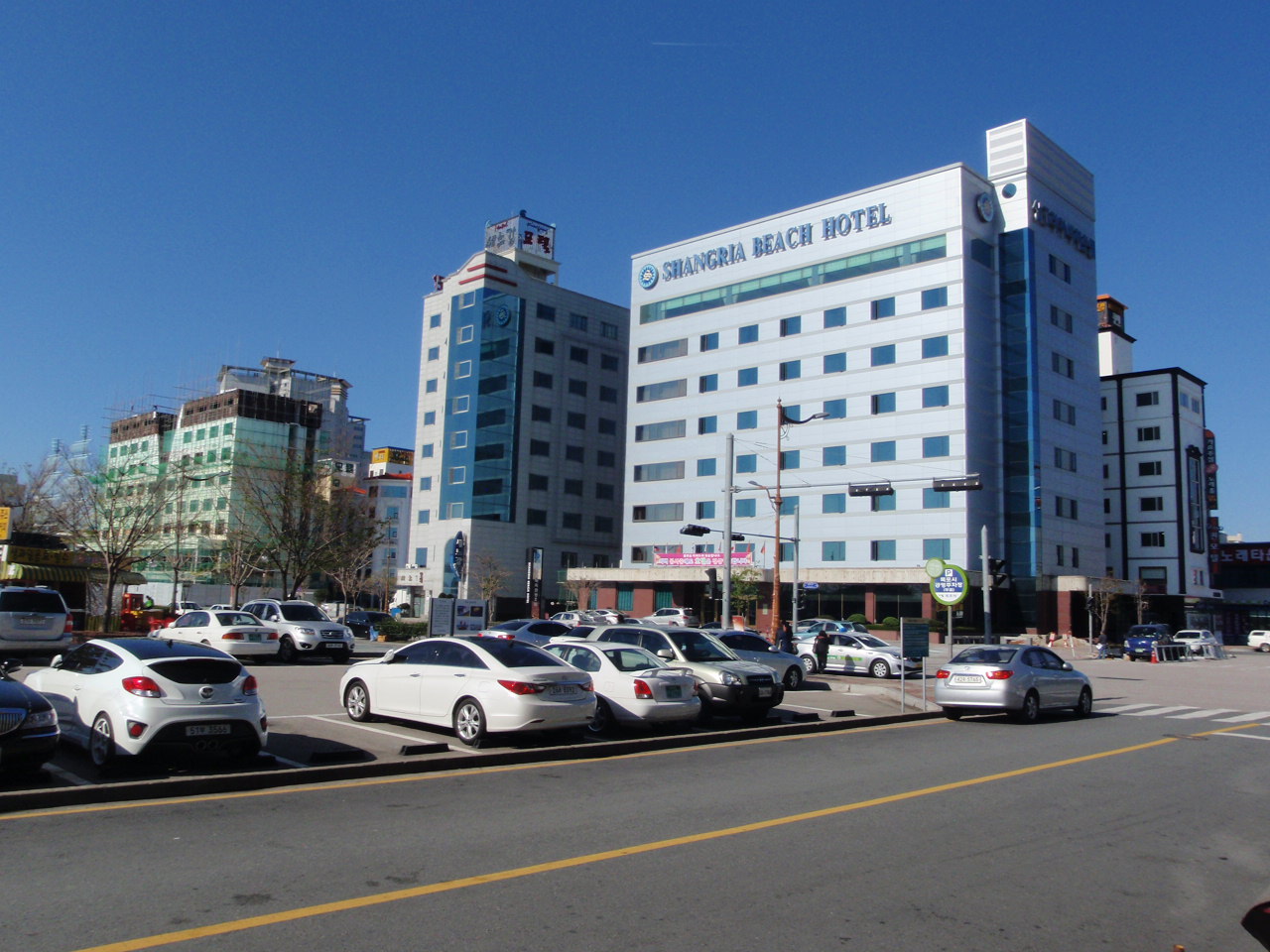
We stayed in a hotel across the road from the Peace Plaza. That’s the place where they have the dancing water fountains. I can’t remember the name of our hotel but it’s next door to the better-known Shangria Hotel. The rooms are good and at 80,000 won per night it’s about two-thirds of the price of its more famous neighbour.

It’s the skinny building in the middle.

From what I can work out there are three entrances to Wolchulsan National Park; Dogapsa temple, Cheonhwang Parking Lot and Gyeongpodae. You can get there by catching a bus from Mokpo to Yeongam and then another bus from Yeongam to Cheonhwang Parking Lot. This seemed a bit of an arse on to me and so we just took a taxi from Mokpo to Dogapsa temple. I’d estimate it at being about fifty kilometres and it took half an hour and cost 35,000 won.

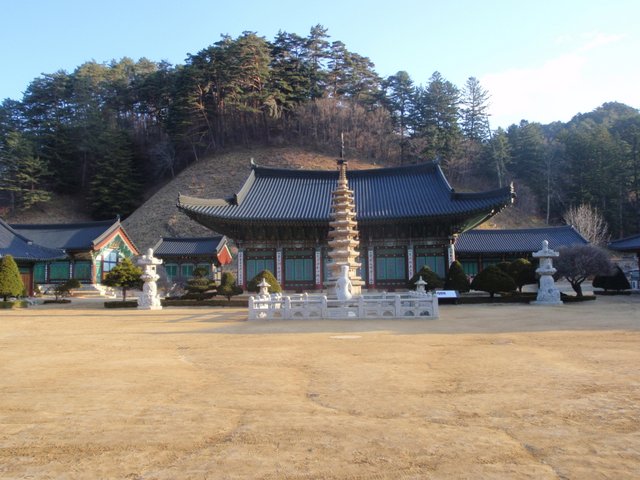
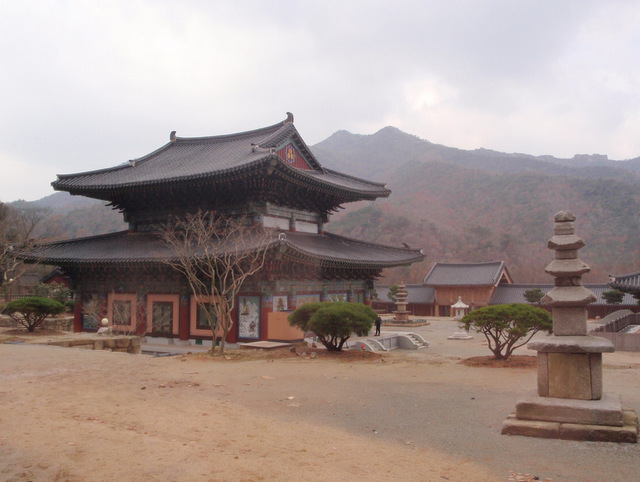
Dogapsa temple isn’t anything special and just looks like most of the other temples over here. I suspect that they were all built by the same bloke. It did have air-conditioning though, which I’m sure the monks will have been very grateful for in the summer.

Dogapsa temple.

The hike that we were intending to do would take us from Dogapsa temple up to the 809m Cheonhwangbong peak and then down to the Cheonhwang parking lot. The National Parks website lists the route as 9.7km and estimates that it should take around six hours. We only had around seven hours of daylight and so couldn’t really afford to hang about.

The trail starts off pretty steeply with an hour or so of ascent until you reach the Pampas Grass Field. Apparently it is silver coloured at certain times of the year but not in November when it looks as if it has died off.

Part of the Pampas Grass Field.

We had maybe fifty yards or so of relative flatness at the Pampas Grass Field and then it was back to the trudging upwards towards the first peak of the day, Gujeongbong. We hadn’t seen too many hikers so far that morning but Gujeongbong was packed with people milling around, having their lunch and just generally making a racket. There’s an easier route up that starts at the Gyeongpodae entrance and I suspect most of them will have made their way up from there.

Gujeongbong.

We didn’t hang about for long at Gujeongbong, partly due to the crowds but mainly because we still had a fair distance to go. The ridge walk to Cheonhwangbong wasn’t the relentless grind upwards that the trail to the first peak had been but there were some extremely steep sections where it was necessary to haul yourself up or lower yourself down using the ropes or rails provided.

Looking back towards Gujeongbong.

Around four hours after we’d set off we reached 809m Cheonhwangbong peak. This one wasn’t nearly so busy as Gujeongbong and it had great views in all directions. We could see the Cheonhwangbong parking lot in the distance and so were reasonably confident that we’d be able to get there before it got dark.

Cheonhwangbong.

On the way down to the car park we had a choice of routes, one going via a suspension bridge, the other by a waterfall. When you are from Teesside you tend not to be easily impressed by bridges and so we chose the waterfall route. I’m glad we did as getting to the suspension bridge appeared to involve an almost vertical climb of around a hundred metres. Once I’m on the way down I like to keep it that way.

It’s no Transporter.

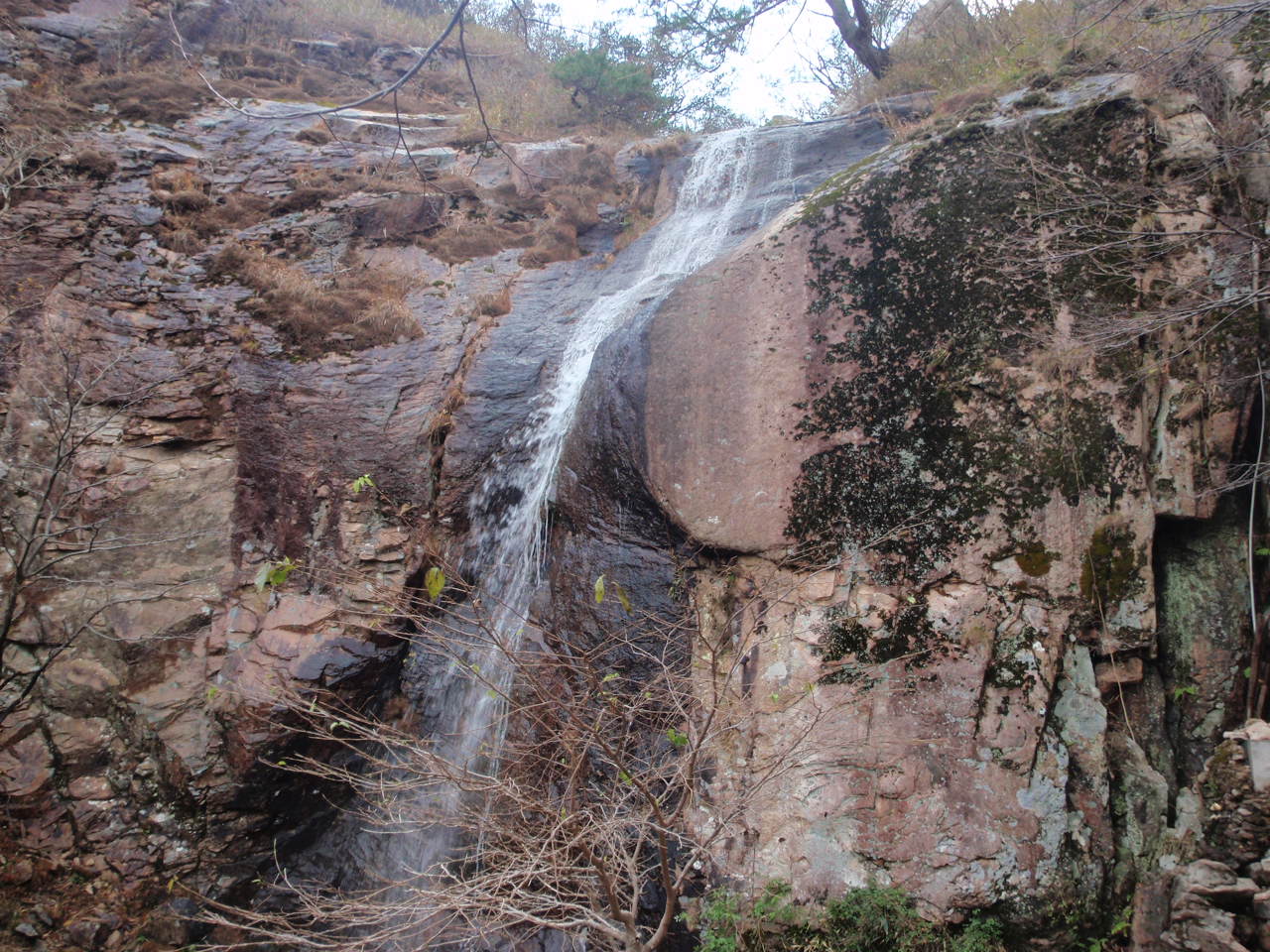
The Baram waterfall wasn’t anything too spectacular but at least it didn’t involve going back up again. There were quite a few people making the walk up from the car park to see it, some on a family day out with a sullen teenager or two in tow, others a couple on a date with the girl wearing heels more suitable for, well I’m not sure what actually. What are high heels suitable for?

And this was no High Force.

Bang on target we reached the Cheonhwang parking lot six hours after setting off. There were far more transport options there than there had been at Dogapsa and we were able to flag down a taxi almost straightaway. Half an hour and 40,000 won later we were back in Mokpo. We had planned to hike the following day too but quickly thought better of it. With my thighs and calves still sore four days later I feel that we probably made the right decision.

Naejangsan Hiking, Sunday 28th October 2012.

November 7, 2012

I haven’t managed as much hiking as I’d have liked this year, partly due to visiting Oman once a month but mainly because of my reluctance to hike in the hot summer whilst carrying more weight than I felt comfortable with. The temperatures are getting that bit colder now though and going for a walk in the mountains is a much more appealing prospect.

Jen and I had been to watch Jeonbuk Motors play FC Seoul the previous day and I’d identified Naejangsan National Park as somewhere that would be easy enough to get to afterwards. When the game finished we took a taxi to Iksan and then caught the KTX to nearby Jeongeup.

I’d marked Jeongeup down as a ‘one-horse town’, probably, I suppose, because it doesn’t appear to have any sporting teams. It’s not necessarily the most logical of assessments but in my book that’s the sort of thing that counts. As even the quietest of towns always have plenty of places to stay though, I was confident of having the pick of the motels around the station.

When we are hiking we will usually book the motel for two nights even when we are only staying for one. It means that we don’t have to check out and carry all of our gear with us and we can return to the hotel for a shower and change of clothes before travelling back to Seoul. It seems a bit extravagant, but with rooms usually costing around forty to fifty thousand won a night it’s not such a big deal.

The first place we tried quoted us 120,000 won per night. I was astonished, especially since we’d be paying double. We tried another motel and they were full. Apparently the ‘one-horse town’ of Jeongeup has a three or four week period in the autumn when it is swarming with visitors keen to see the changing colours of the leaves.

We tried a third motel whilst pondering whether or not we should have stayed in Iksan instead. The motel had one room left and quoted us 80,000 won per night. Despite being twice what they would normally have charged it seemed like a bargain. The room was fairly good too, if a little oddly decorated.

One of the rare remaining rooms in Jeongeup.

It was raining and so we decided not to bother going out to eat, instead getting by on a takeaway of kimchi mondu and kimchi fried rice. The bottles of wine that washed it down meant that we didn’t manage to achieve the early start that we’d planned the next morning and it was after nine thirty before we set off in a taxi for Naejangsan.

It’s a journey that should take around fifteen minutes, but the lure of the leaves caused so much congestion that after half an hour the driver dropped us at a car park a couple of miles from the National Park. There were dozens of coaches, hundreds of cars and thousands of people. It seemed that most of latter were queueing for the shuttle bus that would take them the remaining two miles, despite them being togged up in their best hiking gear.

Lazy gits. The bus is in the distance.

It took us half an hour to walk to the park entrance whilst I suspect that it took those on the bus a good while longer. There was a market at the entrance selling everything from soy beans to twigs for putting in soup. We noticed that a few of the restaurants were roasting half pigs and mentally filed the information for later.

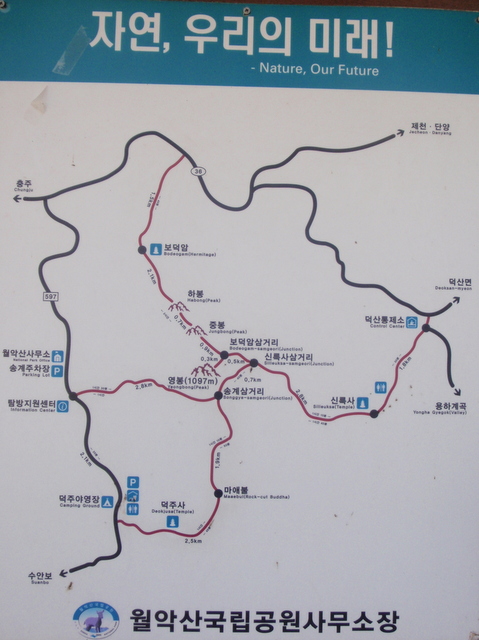
Naejangsan map.

Whilst a lot of the crowd were only there for the shopping, a fair proportion of them kept walking once the stalls had petered out and followed the trail towards a temple and a cable car. There were so many people that marshalls with batons and whistles had to be deployed to keep things flowing. Everytime someone stopped dead in their tracks to photograph the foliage someone else would walk into the back of them and the bottlenecks would build up.

This was once of the quieter sections. Really.

After a further half an hours walking we reached the start of the trail to Janggunbong, a 696m peak a couple of kilometres away. We branched off to the left to follow it and immediately left ninety-nine percent of the crowd behind. Within five minutes we didn’t have another hiker in sight and we encountered far fewer on the way up than you would expect on a normal day’s hiking in Korea.

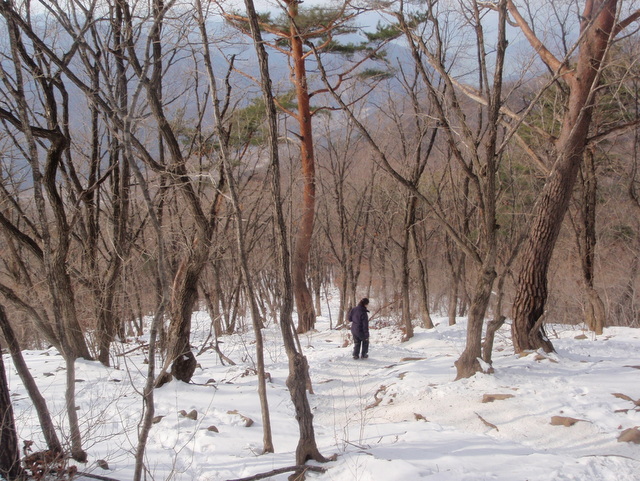
That’s better.

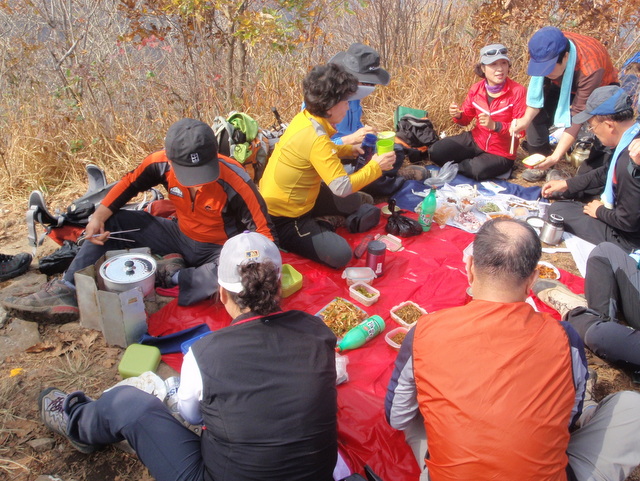
It was a steep climb and it took us an hour to reach the Yugunchi Pass, which is the start of the main ridge and the place where Korean Master Monk Huimuk gave the Japanese a pasting in 1592. Forty minutes later we got to the Janggunbong summit where the crowds of hikers made it difficult to find a place to stand. I suspect that a lot of them had approached from the opposite direction after taking a ride to near the top in the cable car. It’s a shame that there aren’t any Master Monks around these days to keep the crowds down.

It’s an ideal place for a picnic.

We hung around at the peak for ten minutes or so taking in the views. They were pretty much the only ones that we’d seen all day as the trail never really rises above the tree line, even when on the ridge.

We did think about pushing on to the next peak, but the volume of people made us wary about whether we would have enough time to be able to get back to Jeongeup to catch our train. Besides, there were half pigs being roasted at the bottom of the hill.

View from Janggunbong.

We retraced our steps and a little over an hour later we rejoined the crowds on their way to and from the temple. Despite it being mid afternoon the number of people arriving didn’t seem to be getting any smaller.

Still busy.

We had time for some roast pork before we made our way back to the park gate to flag down a taxi. It took us an hour to cover the distance that we had walked in half that time earlier in the day and then a further thirty minutes to get back to Jeongeup. It’s a journey that would normally take fifteen minutes.

There’s enough for a decent sandwich there.

All in all, it was a good day. The foliage was spectacular if you like that sort of thing and the trail that we took well-marked. It was also great just to get out into the hills again. It would have been a completely different experience though if we’d turned up a month earlier or later and had the place to ourselves.

Jeju United v Chunnam Dragons, Saturday 21st July 2012, 7pm

August 2, 2012

Jen and I had turned up at Seogwipo World Cup Stadium last September only to discover that the match had been relocated to Jeju Civil Stadium, some forty kilometres down the road. Whilst it seemed a bit of an inconvenience at the time it did mean that we got to see a game somewhere that rarely hosts one these days and it gave us another reason to return to Jeju.

Ten months later we were on the early morning Air Busan flight from Gimpo. I suppose it probably qualifies as a budget airline with return fares of about eighty quid, but with allocated seats and complimentary drinks it doesn’t seem like one. The flight takes about an hour, but the airport is on the other side of the island so we had close on another hour in a taxi before we reached the start of Section Six of the Olle Trail at Soesokkak.

The fifteen kilometre or so section follows a mainly coastal route to Oedolgae, particularly in the early stages. I read afterwards that there is a sewage disposal plant not too far from the start, but we didn’t see or smell it.  There was a brief detour inland that I suspect was to stop scruffily dressed hikers from wandering across the front lawn of the posh-looking KAL Hotel. We passed a waterfall soon afterwards and then stopped for lunch on the wrong side of a barrier with a danger sign. We didn’t seem to be at much risk of falling into the sea, but there were a few dodgy looking bugs scurrying around at our feet.

Just us and the bugs.

A little later we stumbled across some targets and eventually realised that they were set up to allow tourists to shoot arrows across a bay. I know that Korea does pretty well at archery in competitions like the Olympics, but I felt that it was pushing it a bit to expect tourists to be able to hit a target a hundred metres or more away whilst contending with the coastal breezes. The Olle Trail path isn’t too far away from the targets and it wouldn’t surprise me if every now and again some hiker ends up having his eye out.

I doubt many arrows are used twice.

As we approached Seogwipo Harbour it didn’t look like we had far to go and, as the crow flies, we probably didn’t. What we hadn’t factored in though was the desire to ensure that the route passed every point of interest, restaurant and gift shop in town. At one point we detoured through a park for half an hour only to emerge thirty yards from where we’d gone in.  It did mean that we got to see some golf though as a Korean  LPGA Tour event was taking place in Seogwipo that weekend.

Michelle Wie drives off from the fourth tee.

After a final detour up a hill, Sammae-bong, for some views that weren’t worth the effort we finished up at Oedolgae and then took the much more direct two kilometre route back into town. There are plenty of places to stay around the harbour and we checked into the Milano hotel. It came complete with a sea-view, decent air conditioning and half a dozen mosquitos.

The football wasn’t due to kick-off until seven o’clock and so after taking a taxi to the stadium we had time to get something to eat. For those of you that take an interest in my diet, we had something called Jjimdak. It’s made up of lumps of chicken and potato in a spicy sauce. There was some other stuff in there too, carrots, onions and peppers probably. I took a photo of it but by that stage we’d already eaten a lot of the good bits. We were also given a couple of complimentary fried eggs and some fake Pringles.

There was more potato in it five minutes earlier.

I like the design of the Jeju World Cup Stadium. It only has a roof on one side, but it curls around and is apparently based upon a seashell. I think as interesting designs go, it isn’t quite as good as the Big Bird Stadium at Suwon, but it runs it close.

I took this one last year.

We bought eight thousand won tickets for the east stand, although it looked as if you could use them for the north and south stands too if you wanted.  There were a few hundred Jeju fans to our right and ten Chunnam fans behind the opposite goal. Most people watched, like us, from the east stand.

Jeju were in orange, whilst Chunnam dressed up as Newcastle. That was sufficient to get me rooting for the home side, although taking the generous odds of 8/13 against a Jeju win had already given me an allegiance for the evening.

I was disappointed to see veteran keeper Lee Won Jae had been dropped to the bench for Chunnam, possibly because they had conceded a lot of goals lately. His young replacement seemed quite nervous, although  the way his defence played in front of him it was easy to see why.

Random action shot.

By half-time Jeju were four goals up and it was all over as a contest. Chunnam tried to make a game of the second half and created some decent chances, but Jeju were never really under pressure. Seo Dong Hyeon added another two goals for the home side to give himself a hat-trick and Jeju a 6-0 victory.

Seo Dong Hyeon makes it six.

The win didn’t alter the league tables with Jeju remaining in fifth position and Chunnam in eleventh Whilst I doubt that Jeju will be challenging for the title, it wouldn’t surprise me if Chunnam were to be relegated.

Jeonbuk Motors v Sangju Sangmu, Sunday 1st July 2012, 7pm

July 9, 2012

The heavy rain of the previous day had stopped and with Jeonbuk’s game against the Army team not kicking off until the evening Jen and I took the opportunity to go hiking. There are a couple of Provincial Parks near to Jeonju and we got a taxi to Maisan. We could have got a bus to Jinan and then another one to the Maisan park entrance but it seemed like a bit of an arse on. The cabbie didn’t bother with the meter but instead quoted a fare of thirty five thousand won which I think is reasonable for the thirty kilometre or so journey.

Maisan is famous for a couple of peaks that are said to resemble horse ears. They don’t really though. I suppose at a push you could make a case for cat ears but back in the days when people were dishing out the attributes to mountains I’ve no idea if they had any cats in Korea. Perhaps a horse really was the nearest likeness. Or maybe horses had weird ears back then. I should really have taken a photo before we got up close, but I didn’t.

Here’s a stamp I found on the internet instead.

We hadn’t much of a plan worked out before we got there and after looking at the map near the trail entrance we just set off from the North Car Park towards the horse/cat ears. After a decent slog up a wooden staircase we reached the point where the path led to one of the peaks. Unfortunately it was shut and so we had little option but to carry on towards the South Car Park.

A monk talking on his mobile never looks right.

A few minutes further along the path we arrived at Tapsa Temple. Normally I’m not too fussed about temples, most of them have been rebuilt a few times and when you’ve seen one, you’ve seen them all. This one was different though and seemed more like a fairy grotto in a theme park than a temple. It had waterwheels, little huts with Buddhas in them and more stone animal statues than a garden centre. Apparently it had been built at the back end of the nineteen century by some fella who had decided to move to the hills and live on raw pine needles. I suppose he wouldn’t have been spending much time cooking or washing up.

All it lacked was a crazy golf course.

Further along the trail we had the option to veer right and head up to a smaller peak. The path started with a section where you needed to haul yourself up steep wet rock. We decided not to bother and just pushed on towards the South Car Park instead where after a couple of hours hiking we got a taxi back to Jeonju. I’d recommend Maisan when the trail to the top of one of the ears opens again, or when the conditions are a bit drier. There are plenty of restaurants at the South Car Park and the smoked pork ribs looked well worth a try.

Jen needed to be back in Seoul earlier than the 7pm kick-off in the Jeonbuk v Sangju Sangmu game would allow and so she dropped me off at the World Cup Stadium on her way to Iksan station. Jeonbuk are on a bit of a roll at the moment, having won their previous seven matches to move to the top of the table and I wasn’t really expecting the Army team to cause them any problems.

I was quite early going in and so had my pick of the seats in the East Stand. It’s the most popular area and by the time everyone had arrived there were probably three or four thousand people sharing it with me. Unfortunately there were only around a thousand others in the rest of the ground meaning the true attendance was well short of the 8,800 claimed by the stadium announcer.
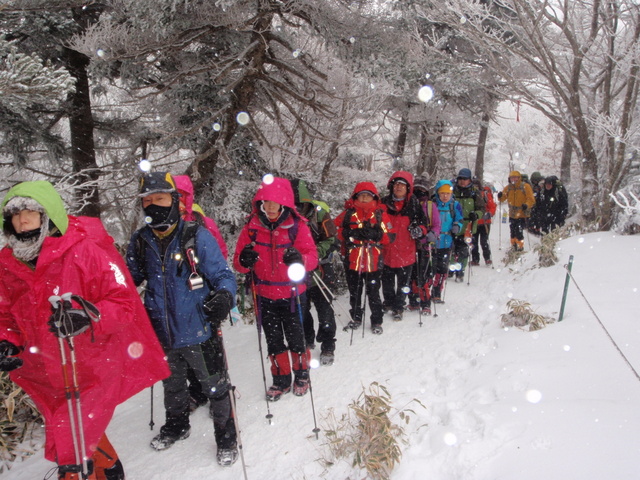
The travelling Sangju Sangmu support.

Lee Dong Gook was in the starting line-up for Jeonbuk alongside Eninho and Droguett. Luiz Henrique was on the bench whilst Sangmu’s sub goalie Kwon Soon Tae received a warm welcome from the Jeonbuk fans ahead of his planned return in October once his National Service is complete. The visitors managed to deny Jeonbuk for about ten minutes before Chilean striker Hugo Droguett cut in from the right wing and curled a left footed shot into the far corner.
The home fans celebrate the opening goal.

That was the only goal of the first half and with not much worth eating inside the ground I nipped out at the interval for some exceptionally crap fried chicken. You’d think that I would have learned by now that the chicken on sale before the game is never too clever a choice an hour or so later.

Her chicken looked much better.

Twenty minutes from the end Droguett added his and Jeonbuk’s second goal, finishing off a move from about fifteen yards out. As I’d backed the home side to win by at least three, I was hopeful that his effort wouldn’t be the full extent of the scoring. Jeonbuk had a few more chances, notably one where Lee Dong Gook tried to round the keeper but only managed to pick up a yellow card for diving rather than the penalty he felt that he deserved.

With no more goals I lost my bet but Jeonbuk picked up the three points to stay top of the league and extend their winning run to eight games.

Jeonju EM v Paju Citizen, Saturday 30th June 2012, 3pm

July 7, 2012

It’s a while since I’ve been to a football match over here as I spent a fair part of June in Europe. I caught up with family in the UK and squeezed in a trip to the European Championships with my mate Paul. We only saw the one game live, Croatia v Italy in Poznan, but it was enjoyable enough spending a week watching two games each day in a variety of Polish bars.

It’s never dull when the Croatians are in town.

We managed to get some hiking in as well, briefly crossing the border to get to the top of the highest mountain in the Czech Republic, the 1602m Sněžka. I sent my Mam a Czech postcard just for the confusion value as to where I was. Paul managed to tick off the tallest peak in Poland, the 2499m Rysy in the High Tatras. That was a bit much for me but I had a pretty good time wandering around a thousand metres lower in the valleys.

I had my lunch above the snow line.

I got back to Korea just in time for the rain. I’ve worked the seasons out here now. Initially I’d bemoan how quickly Spring came and went with it sometimes only being three days between needing the heating on and having to use the air-conditioning. Really though, when Koreans proudly tell you that they have four seasons what they mean is Winter, Summer, Rainy and Autumn. Winter is cold, Summer is hot, Rainy is wet and Autumn is when it’s just about perfect for hiking. That one is a good couple of months away yet though and before then we are in for a few weeks of heavy rain.

Jen and I try not to let the fact that it’s pissing down spoil our fun if we can help it and so we caught the train to Jeonju on Saturday morning and checked into the Feel Motel near to the bus terminal. We’ve stayed there before and it’s clean, cheap and convenient. Well, convenient if you want to be near the bus terminal that is. It makes a point of advertising that it has a 24 hour porn channel, as if this is something out of the ordinary in a Love Motel. I reckon that there will be more motels without beds than there will be without at least one adult channel. We checked it out and it was so softcore that we couldn’t be certain that it actually was porn. I thought that the invention of the internet would have made that sort of malarkey on the telly redundant, but apparently not.

The Feel Motel, Jeonju.

As it got to the scheduled kick-off time of three o’clock it was still pouring down and we were still in the motel. We decided to get a taxi to Jeonju University where the game was due to take place, drive up to the pitch and after confirming that the match had been cancelled, get the taxi driver to take us to a bar somewhere. It took a bit longer to get there than I’d expected and there was a brief lull in the rain as we arrived. I nipped out of the taxi and was astonished to see that not only was the game in progress, but there were a couple of hundred people watching from the small stand by the side of the pitch.

That’s the university in the background.

It turns out that the Jeonju University grass pitch is actually artificial turf and so able to cope with a decent downpour. Half an hour had gone and the visitors, Paju, were a goal up. We found a couple of seats towards one end of the bus shelter style stand where not too much rain was blowing in and the drips from the roof weren’t too frequent.

Certainly not just fair-weather fans.

It didn’t take Paju long to double their lead with one of their strikers finishing well after catching the home team with a quick break. At half-time the subs seemed to resent having to warm up in the rain and I couldn’t blame them. Whilst it’s quite enjoyable playing in the rain, it’s not quite as good arseing about for ten minutes before going to sit back down again in wet kit.

It was quite a niggly game, not helped by players sliding into tackles from five yards away. You’d think that in those sort of conditions the players would have come to a consensus that it would have been better all round if everyone stayed on their feet.

Jeonju are in white, Paju in red.

Jeonju pulled a goal back a quarter of an hour from the end and the game looked set for an exciting finish. The goal coincided with the rain easing up somewhat though and good as it would have been to see if the visitors could hang on, we took the opportunity to leg it whilst we could. A quick check later confirmed that Jeonju got their equaliser and the game finished two each.

Gayasan Hiking, Sunday 22nd April 2012.

May 3, 2012

I’ve not done very much hiking so far this year. Jen and I walked the last couple of sections of the Bukhansan Dulegil and there’s been the odd river walk on the way to a football game, but I haven’t been up a mountain since I went to Yongmunsan back in mid-January.

As I’m supposed to be going up Poland’s highest mountain in the summer when I’m over there for Euro 2012, I thought that it was about time to ease my legs back into it. Jen and I had been to Cheongdo to watch the bullfighting the previous day and when we had seen enough of that we got the train to Daegu. A taxi took us across the city to the Seobu bus terminal and from there we caught a bus to Haeinsa in the Gayasan National Park. The bus goes every forty minutes, costs 6,600 won and takes about an hour and a half.

Seobu bus terminal.

It was raining as we arrived at Chi-in village and we made for the nearest motel. There were a few of them around so I reckon that even in the height of the walking season it would be likely that you would find somewhere to stay.

Our place was ok, the main drawback being that not only would the outer door to the room not lock, it wouldn’t always stay closed. I wasn’t too bothered as it didn’t seem as if there was anyone else staying there. Later on Jen spotted a list at reception that not only showed which rooms were occupied, but how many people were in them. We had the lowest occupation rate with just the two of us, whilst other rooms had as many as eight people crammed into them.

That’s it on the left.

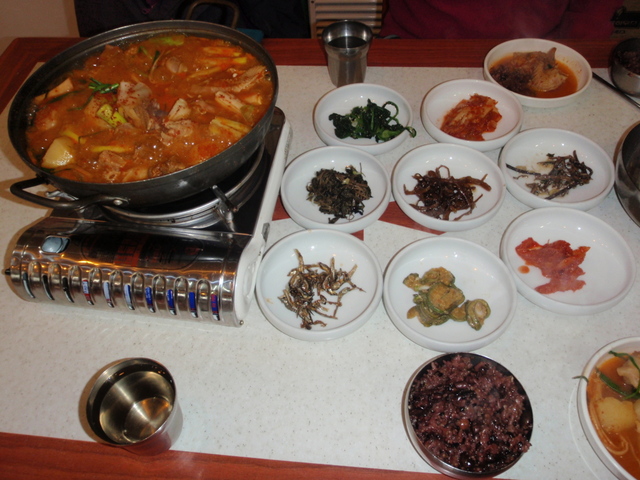
There were a few restaurants and we selected one that specialised in various produce from the surrounding hillsides. Radishes, ferns, bracken, surplus foliage from root vegetables, weeds, that sort of thing. There was an ungutted grilled fish and some soup with bits of tofu in it. On the plus side we got a pancake and a couple of beers with it.

It was quite cold in there but as we were the only customers we got to sit next to the stove. On top of the stove was an extremely large pot full of water. I wasn’t sure if they were heating it up to make us some tea or to bath their dog.

Just in case you wondered what a stove looks like.

Next morning the rain had stopped and it was a pretty good day for hiking.  We set off early in the direction of Haeinsa temple with the intention of walking past it and then onwards to the 1,430m Sangwangbong. It’s about five kilometres to the top and with Haeinsa being around six hundred metres above sea level, it’s a not too steep eight hundred metres or so ascent.

Haeinsa is famous amongst Buddhists for its temple which has a load of wooden printing blocks from the olden days. Jen has been there before and they made her peek through a gap in the wall to see them, so it’s maybe not the most tourist friendly of places. That didn’t seem to stop coachloads of them turning up though and by the time we reached Haeinsa it was already busy.

I’m not overly fussed about old wooden blocks and so we left them to those who were. The trail towards the summit was the quietest we’ve ever experienced. We spotted a monk out for a stroll early on and then after that we didn’t see anyone at all until we were within about twenty metres of the top. There’s an alternative route up from the Baengundong park entrance and most people must have been following that trail. We did think about going down that way but we didn’t know if we would be able to get a bus or not.

A monk.

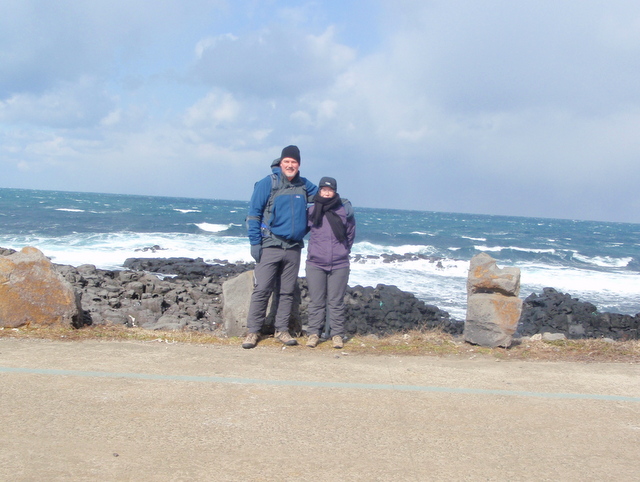
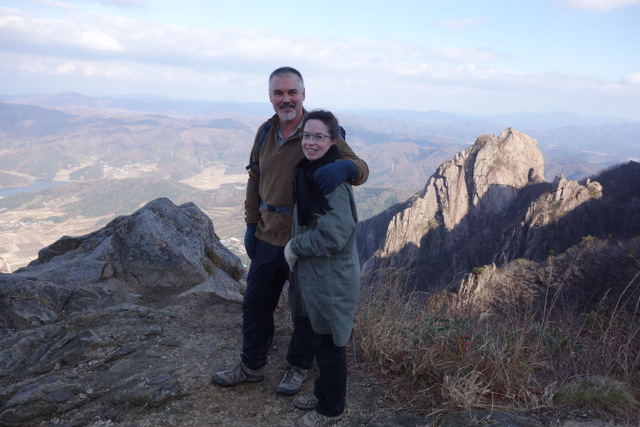
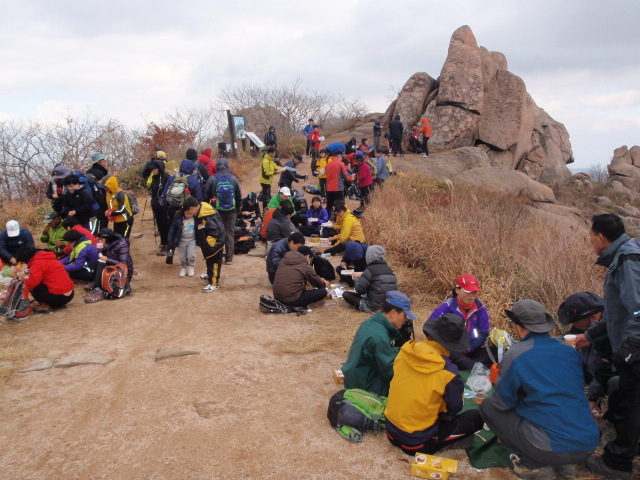
Three hours after setting out we were on top of Sangwangbong. For a few minutes we were the only people up there before someone very handily turned up to take our photo.

It’s been a while since we had a summit photo.

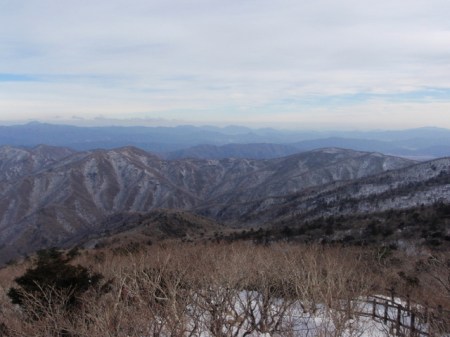
There were decent views to the south with rows of mountain ranges disappearing into the distance.

I think I took this one a bit further down, but the view was similar.

The route was busier on the way down as we passed hiking groups and families who hadn’t made the early start that we had. Two hours later we were at the bottom and having a late lunch of beef and mushroom soup in a restaurant next to the bus stop.

Timetable for buses from Haeinsa.

Gayasan is another one of those places that I’d like to go back to, next time taking the route from Baengundong that goes past Yonggi Falls and then on to the 1,433m Chilbulbong peak, before descending via Sangwangbong to Haeinsa. It’s still only about ten kilometres in total and it looks as if the best way to do that one is to get off the Haeinsa bus a bit earlier at Gajo and then take a taxi to the Baengundong entrance.

And for what it’s worth, my legs knacked for days afterwards.

Hanwha Eagles v Nexen Heroes, Sunday March 18th 2012, 1pm

March 30, 2012

After watching the FA Cup first round tie between Cheongju Jikji and Ajou University the previous day, Jen and I had stayed over in Cheongju for a pre-season baseball game. There are plenty of motels in the area around the bus stations and we selected one on the basis of its towers, stone cladding and the fake bronze bust in its doorway.

Nice bust.

It was exceptional value at 30,000 won, with a 42“ television, a computer in the room and far fewer hairs in the bed or bathroom than you would expect at that price. The only thing that it was lacking was a control to turn the heating down and so we had to regulate the temperature by sleeping with the window open.

The baseball wasn’t due to start until 1pm and so in the morning we got a taxi to Bumosanseong fortress wall. There are two fortress walls in Cheongju, Bangdangsanseong and Bumosanseong. Don’t worry, I won’t test you on the names. Bangdangsanseong is better, but Bumosanseong is closer to where we were staying and so that is where we went.

The taxi took us to within about fifty yards of the top of Mt. Bumo and we got decent views in all directions. The wall didn’t appear to have been restored and a lot of the time we were walking on top of it. It didn’t take long to get all of the way around though and as we had time to spare we walked all of the way back to the town centre.

It's just like that one in China.

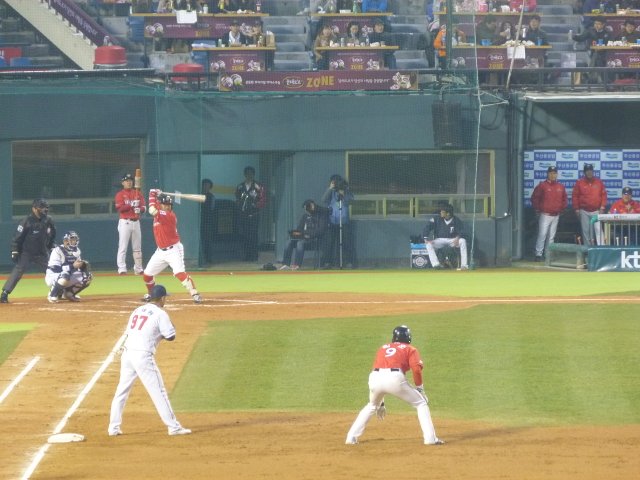
Jen had stuff to do and so I went to the baseball by myself.  A taxi dropped me off outside Cheongju Baseball Stadium ten minutes before the start. I’m glad I didn’t have a car to park as the car park was full. In fact, all the roads leading in and out were packed with cars as well, parked three abreast and stopping anyone from leaving out of turn.

I was quite surprised by how busy it was. This was a pre-season game between two teams that aren’t particularly well supported. Although I suppose that Hanwha playing in Cheongju rather than their usual stadium at Daejeon probably had a lot to do with it. As did free admission and people pining for some baseball after the winter. So I shouldn’t have been suprised really.

The stall-holders were out in force too, mainly selling chicken, silkworms and beer. I didn’t bother and just went straight into the outfield section of the stadium.

On the way in.

Cheongju Baseball Park has a capacity of twelve thousand. At the time the game started I’d estimate that it was around half full. People continued to turn up over the next couple of hours and I’d say the attendance peaked at around ten thousand. Of course, there were no seats to be had later on as latecomers had to compete with the handbags and boxes of chicken that were occupying the remaining places.

You need a chair for your beer.

For those who hadn’t brought their own food, there was plenty available inside, although I’m not sure if this woman was selling the stuff on her head or just replenishing the picnic lunch for her family.

A quick snack.

I was impressed with the stadium. It had ten rows of seating all of the way around, with a roof over the posh seats behind the plate. Ideal for a sunny day really.

The view fron the outfield.

Hanwaha got off to a decent start in the first innings with the popular Kim Tae Kyun cracking a three run homer to within a few yards of me.

Kim Tae Kyun - Hanwha Eagles

Hanwha got a another run in the fourth and then increased their lead further in the fifth when Jung Won Seok made it five-nil with a hit that again landed just in front of me. A fella in the crowd actually caught that one and prevented the usual scramble for the ball from blokes old enough to know much better.

Jung Won Seok collects a quid from each of his team mates after his home run.

Nexen didn’t really put up much of a show on the day, but that didn’t matter. The home crowd were happy just sat in the sunshine watching Hanwha knock the ball around at a stadium that they rarely visit. As was I.

That's not a bad seat.

I had a bus to catch so left in the seventh before Hanwha added another run in my absence to take the game six-nil. I expect that both of these teams will struggle again this season, particularly Nexen, but that’s for their fans to worry about, not me.

Yongmunsan Hiking, Saturday 14th January 2012

January 19, 2012

Yongmunsan is one of those mountains that is just outside of Seoul and ideal for a day’s hiking. Ideal that is if you can get out of bed on a morning. I’d planned to do this hike the previous Saturday but hadn’t adjusted properly to the time difference after my trip to the UK. Whilst I’d been waking up at around three every morning earlier in the week, luck would have it that I slept in until half past nine on the Saturday, which was a bit too late.

My second attempt was a little better. I’d been to Oman and back during the week, returning to Seoul the day before and had hoped that with the time difference there being only five hours rather than nine I’d wake up sometime around seven o’clock. Hoping isn’t really as good as an alarm clock though and after not waking until eightish, it was after nine before I left the apartment.

Yongmun is at the very end of the Jungang line and it took about two and a quarter hours from Yeoksam. I had a seat all the way and a book to read so didn’t mind the journey, particularly as the latter stages are above ground with views of some of the other mountains that I’d like to hike in the future. It’s only a 1,900 won fare as well which is about a quid.

I could have got all the way to Yongmunsan Resort for that 1,900 won fare if I’d been prepared to wait for the connecting bus that runs every half hour from the station, but as it was getting on towards lunchtime I took a 10,000 won taxi instead.

Yongmunsan Resort is likely to be quite a busy place in summer. There’s an amusement park, a camping ground, plenty of restaurants and a few small hotels. In January though, there wasn’t a great deal going on.

That's the big hill in the background.

I followed the road that leads to Yongmunsa Temple. It’s another one of those places that is apparently centuries old, but there is still construction work going on. It’s ages since the Japanese invaded and knocked it all down so maybe the monks are getting an extension to their Snooker Room. There is a great big Ginko tree outside the temple that is supposed to be over a thousand years old. It probably looks a bit more impressive when it has leaves on though.

That's still the big hill in the background.

I followed a path that went between the tree and the temple. A hundred metres or so further on I had a choice of following a path towards Sangwonsa or going directly to the main Yongmunsan peak. I headed straight on and the trail went upwards quite sharply, following the frozen stream. There weren’t many people hiking, or at least there weren’t too many on this particular route, although I suspect that most people would have started walking a little earlier than I did.

As I got higher there was more snow on the ground. It didn’t look too recent though.

Looking back in the direction that I'd just come from.

Progress was slow as there were some fairly slippery parts of the trail. The ice wasn’t thick enough to put chains or spikes on, so it was just a case of being careful. There were some quite steep sections as well where the ropes provided were a big help. After two and a half hours I’d only covered three of the four kilometres to the top and realised that I might not make it down again before dark if I tried to do the last kilometre. Yongmunsan is one of those mountains where you can’t get all the way to the 1,157m summit anyway as it’s fenced off to protect a load of satellite equipment, so not getting to the highest point possible wasn’t such a big deal.

I backtracked  to one of the lesser peaks and perched on a big rock to eat my cheese and crackers. I had a great view of the valley that I’d started from, some other hills in the distance and a bloke doing a bit of paragliding.

The photo doesn't really do it justice.

Further along the trail I took a different route downwards which eventually joined up with the route to Sangwonsa. It meandered back and forwards and was a lot less steep than the route I’d followed on the way up. It made the descent much easier than I’d anticipated and by the time I got back to Yongmunsan Resort I probably still had about an hour and a half to spare before it got dark.

I went up the blue route and came back down the yellow. I think.

I joined the queue of hikers waiting for the bus to the station and then got the subway back to Seoul. I think I’ll have another go at Yongmunsan as there is apparently a decent waterfall fifteen minutes or so beyond the main peak. I’ll just set off a little earlier next time.