Archive for the ‘Hiking’ Category

Goyang KB v Changwon City, Saturday 12th November 2011, 3pm

November 28, 2011

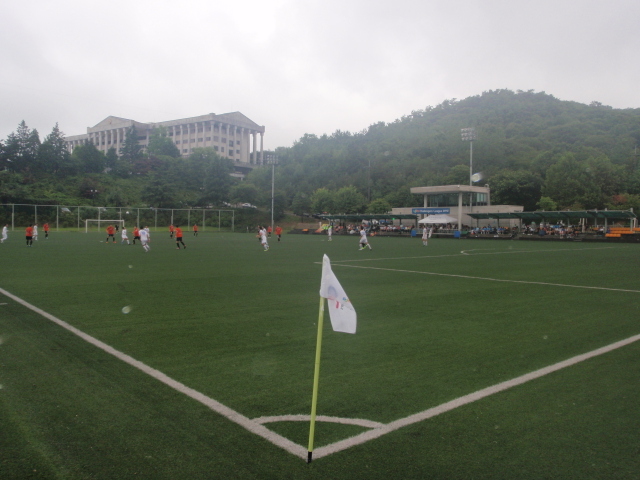
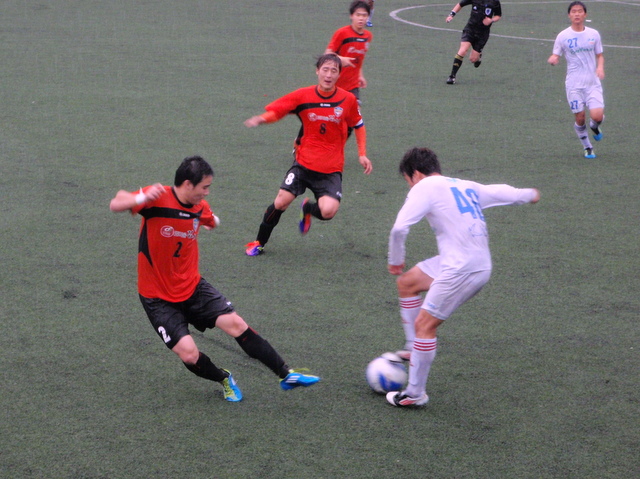
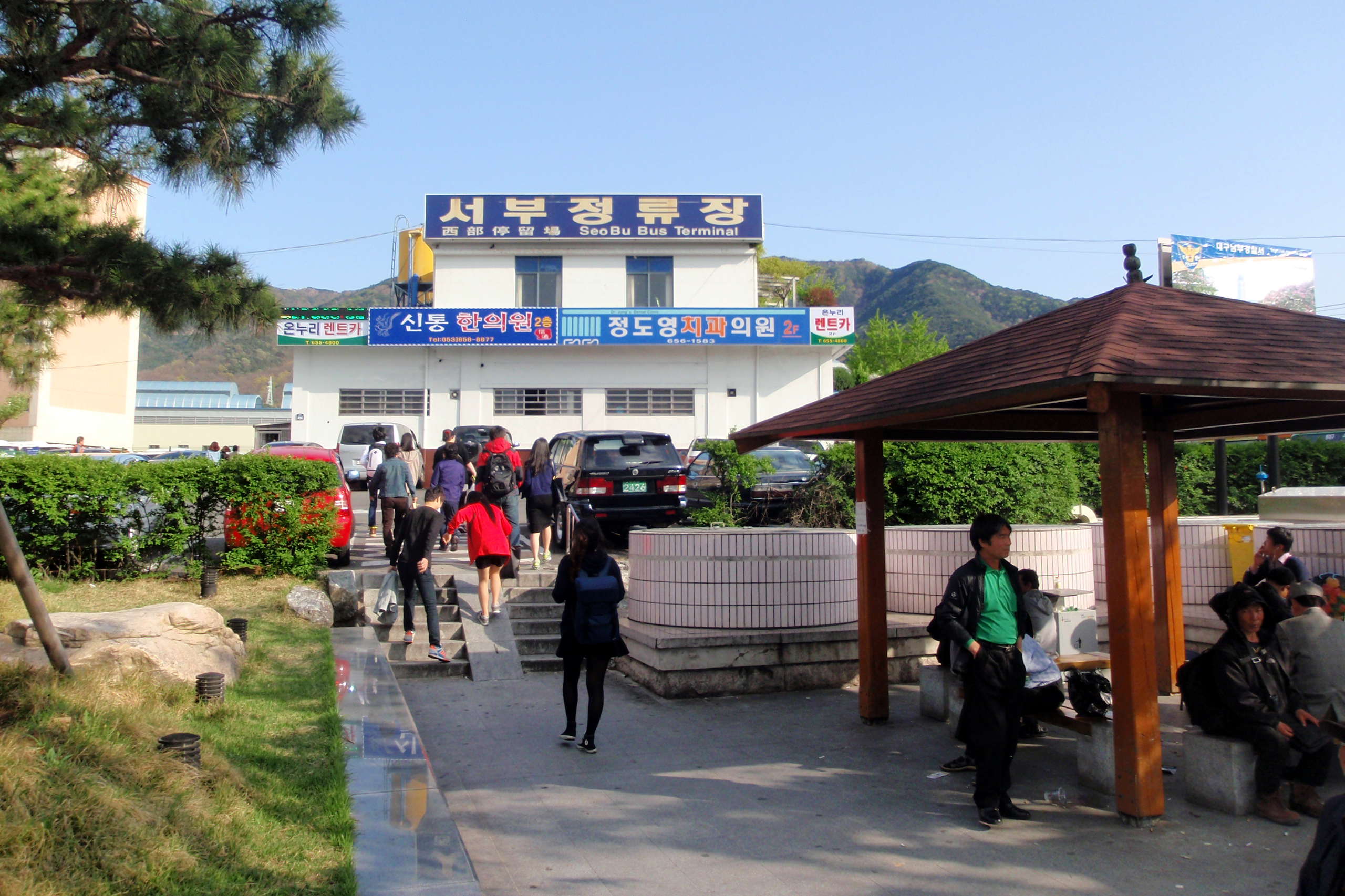
I tend to plan the matches that I’m going to quite carefully. It makes sense really, particularly if for example, you want a seat on the train journey there rather than having to stand between the carriages. I hadn’t intended going to any games over this weekend though. There were only two fixtures scheduled, a second division play-off at Goyang on the Saturday and a third division play-off at Gyeongju the following day. I’d definitely have gone to Gyeongju if I could have as it’s somewhere I haven‘t been to yet, but unfortunately I was flying to Oman on the Saturday night so couldn‘t get there. I decided not to bother with Goyang as I’d been to see them play at home a few months ago.

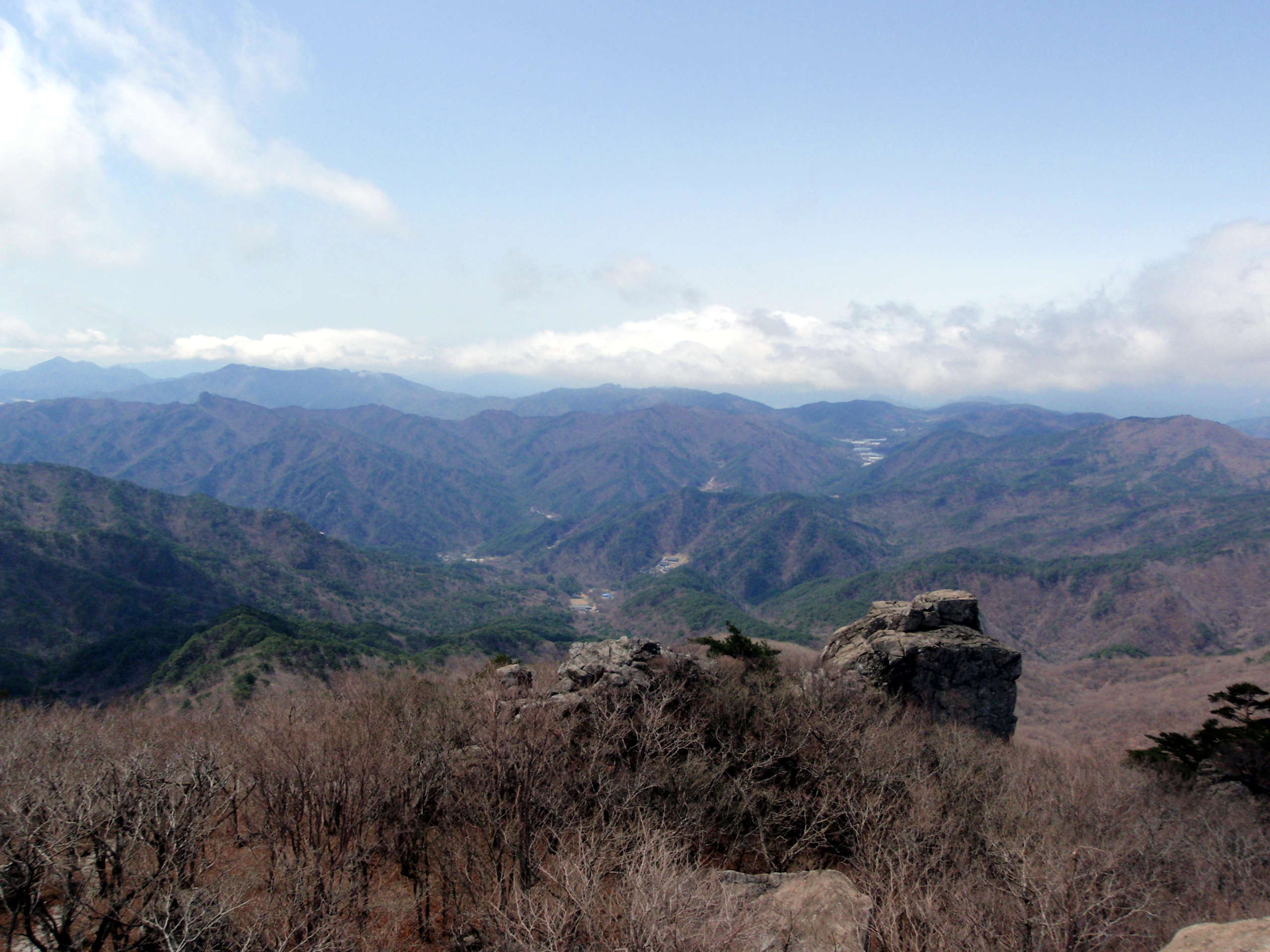
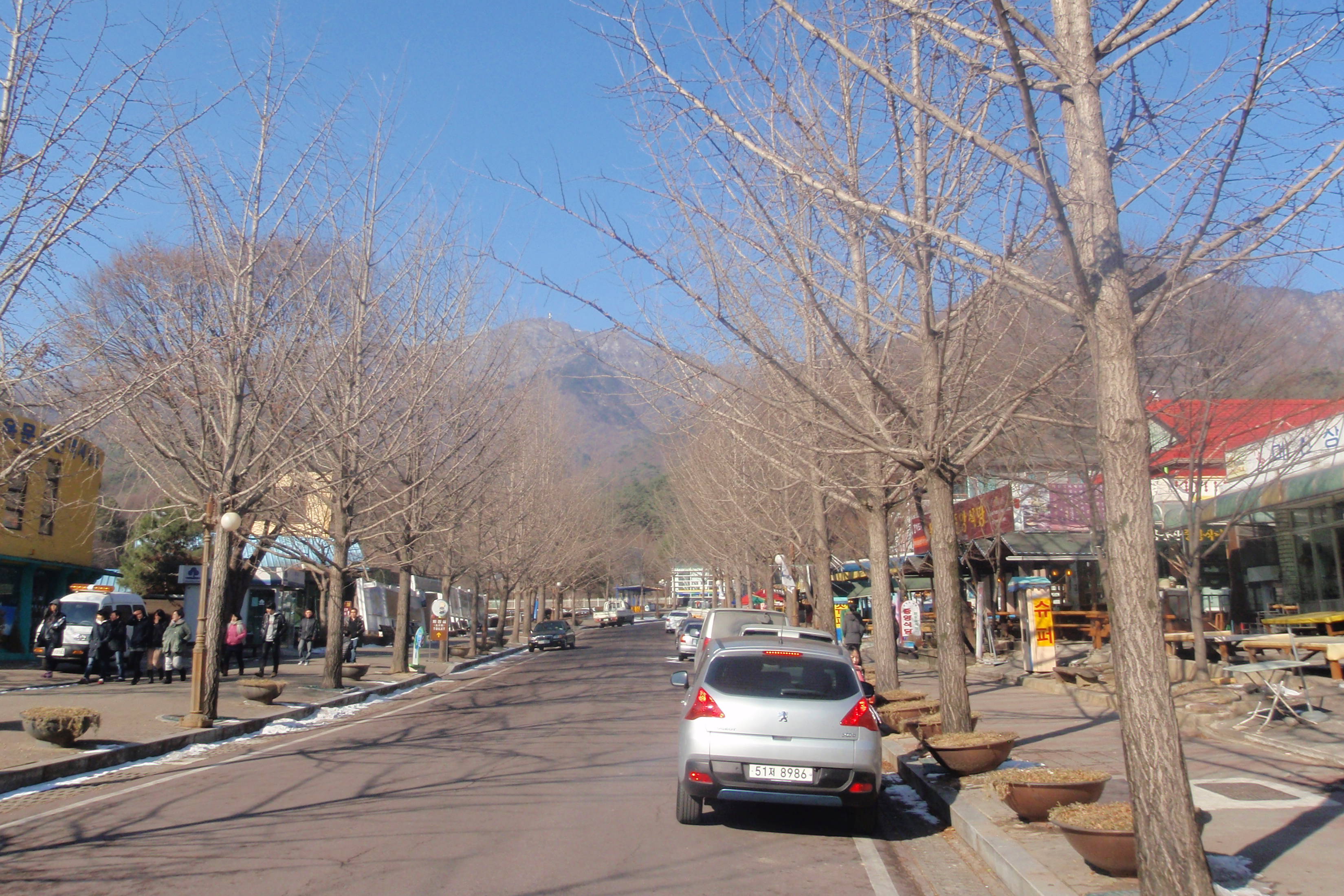
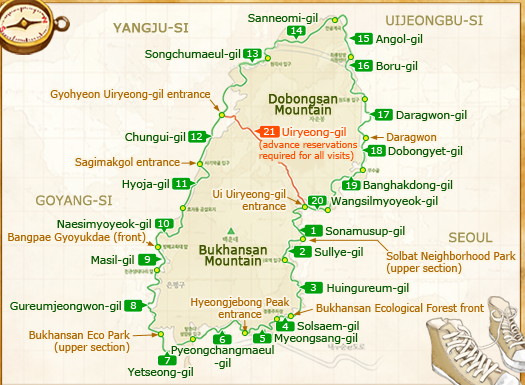
It’s perfect hiking weather though and since I didn’t really have time to get out of Seoul Jen and I decided to walk a bit more of the Bukhansan Dulegil. It’s a trail that follows the outskirts of the Bukhansan National Park. It doesn’t go up any of the really big hills but it does make for a pleasant day out in the countryside. The first phase opened last year and we’d walked all 46km over three days. A new section was added this year with an extra 26km and so we thought we’d walk about half of that and save the remainder for another time.

Bukhansan Dulegil - Courtesy of the Korean Tourist Board

We took Line 3 as far as Yeonsinnae and then caught the 704 bus. We could have stayed on the subway for a further stop to Gupabal, but by that time the bus would have been more than full. It‘s better to start from Yeonsinnae if you want to be able to get on the bus without fighting. Fortunately we knew where to get off from last year, although if you get off anywhere that other hikers do then you are likely to be somewhere on the dulegil.

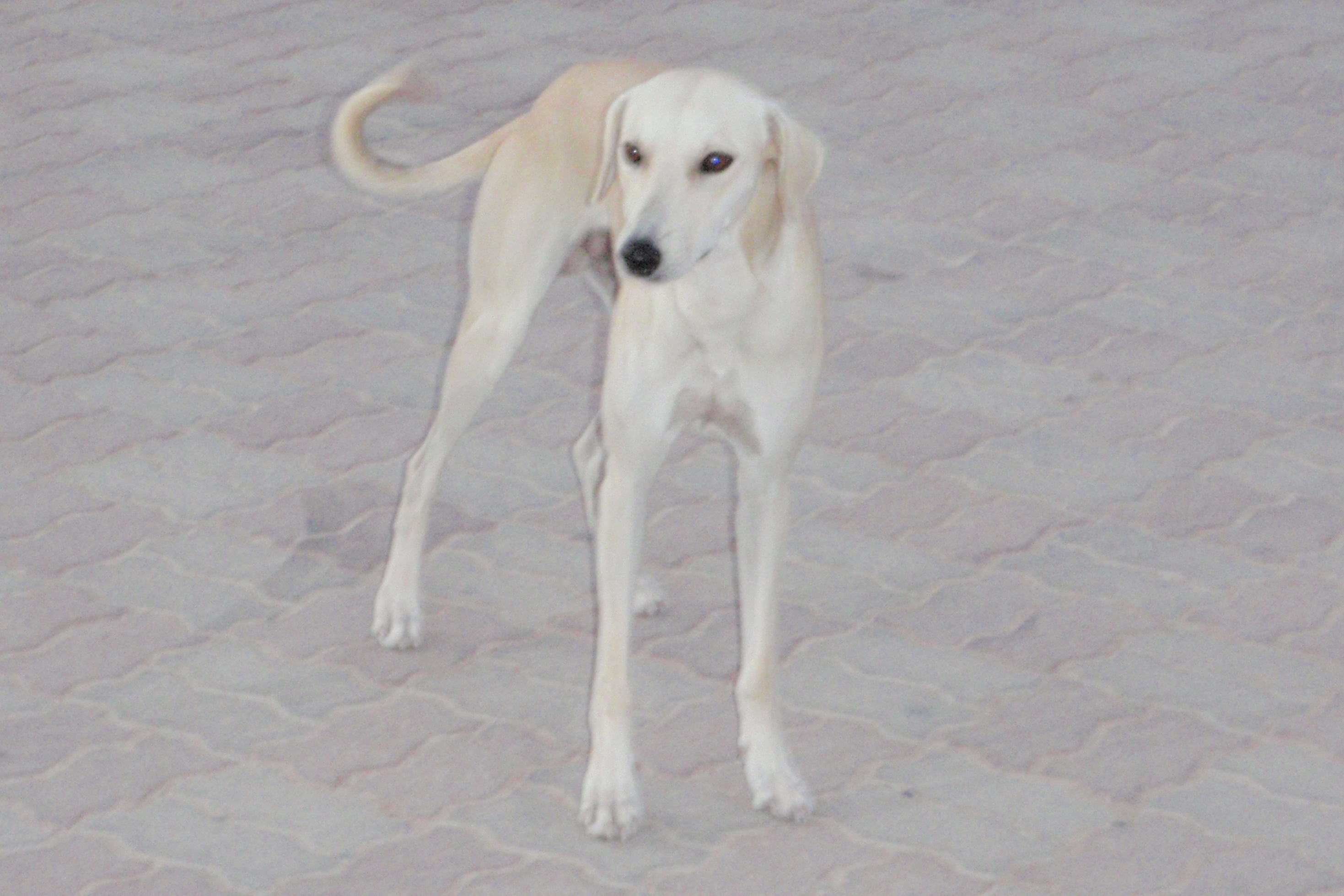
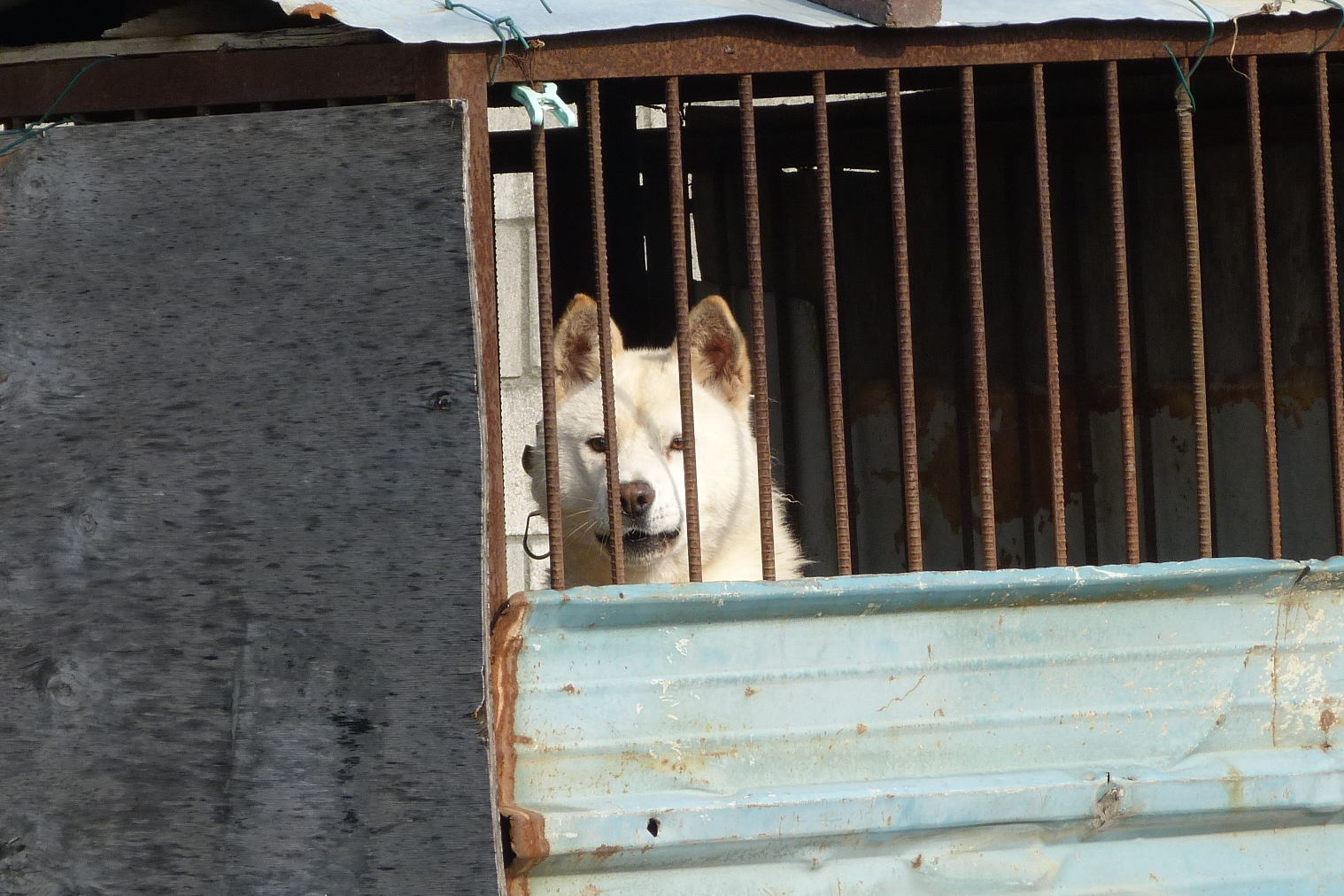
Someone has done a bit of work on the trail since we last walked it and the route has now been divided into twenty-one sections. The new part consists of  section numbers 13 to 20.  Our plan was to walk sections 13 to 16 which is about thirteen kilometres. Section 13 took us through what were mainly farming areas. We saw the locals harvesting their radishes and had a look at a couple of cow sheds. Each farm had a dog or two that had probably never had to bark at anyone until the dulegil was routed past their kennel.

Dulegil Dog

Section 14 involved a few more uphill sections, but still nothing too strenuous. There was a mountain, Sapaesan, close by but we skirted around it without gaining too much height.

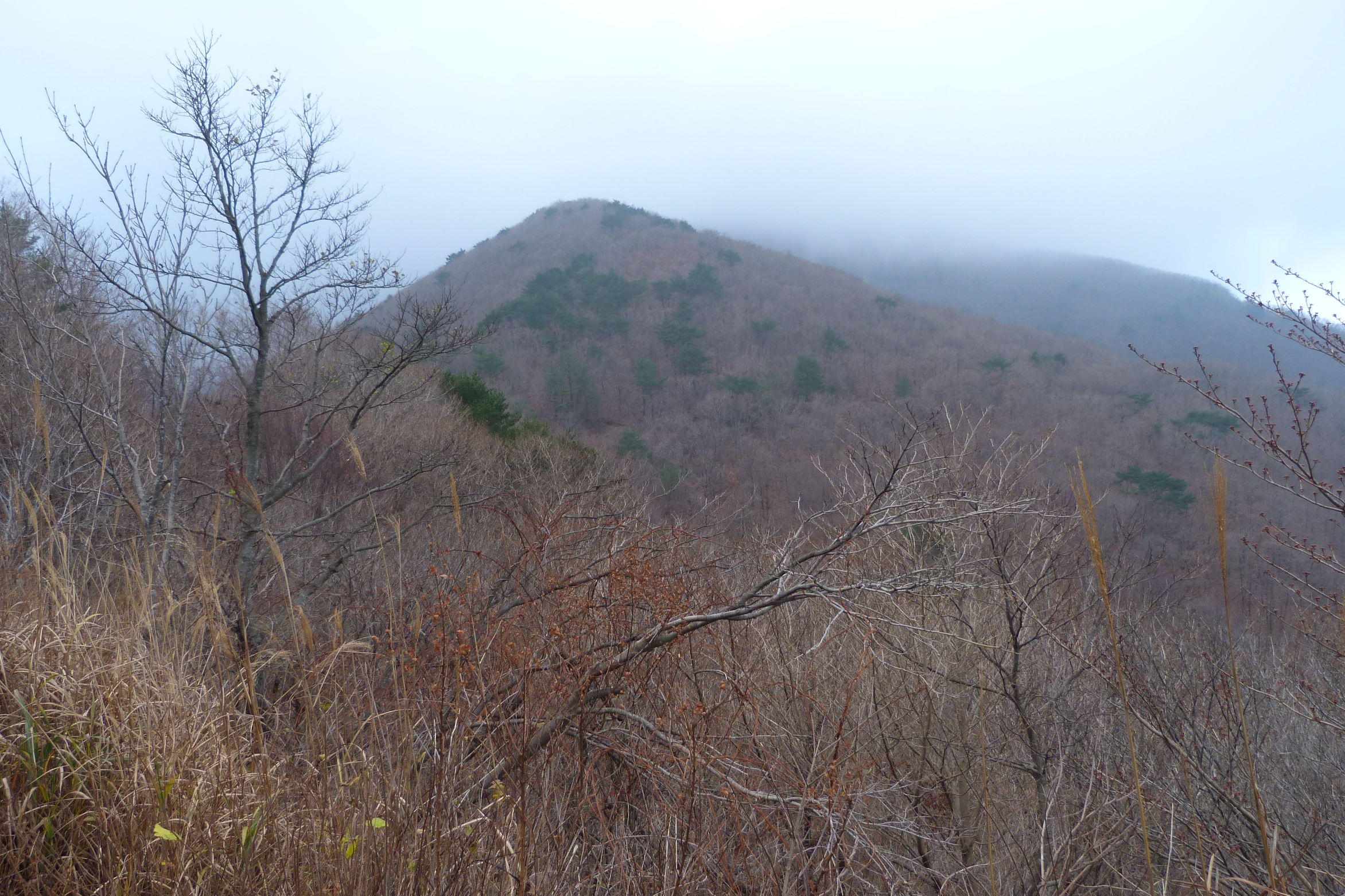
Sapaesan - It should still be there next time.

We’d made good progress on the first two sections and I was starting to wonder if we might get any further than we’d intended. That was until we took in the view of the Angol Valley in section 15. To the left I could see a football stadium and it occurred to me that it would probably be Goyang’s ground, the team that had a play-off game that afternoon at 3pm. Now it’s one thing deciding not to bother seeing a match when you are looking at the details online. It’s quite another matter when you can see their stadium and it’s within walking distance. It would be a bit of a trek, but since we were almost there, how could we walk past and not go?

That's with 24x zoom.

If there had been any doubts about abandoning the dulegil for the day, they disappeared when we realised we had already wandered off the trail by 900 metres. So, Goyang v Changwon it was. Or rather it wasn’t. When we arrived at the stadium it turned out not to be Goyang’s ground, but Uijeongbu Stadium. I’d never heard of Uijeongbu. They don’t have a football team, just a stadium to entice hikers down from the mountains.

If only I'd had 48x zoom, I could have read the sign.

Goyang couldn’t be far away though, so we hopped in a cab. We might as well have asked the fella to take us to Ayresome Park for all he knew about Goyang. He made a few phone calls though, told us it was a long way and set off. An hour and thirty odd kilometres later we arrived at the correct ground. By now it was almost half time, so we took our time, ate some Mandu and went in for the second half.

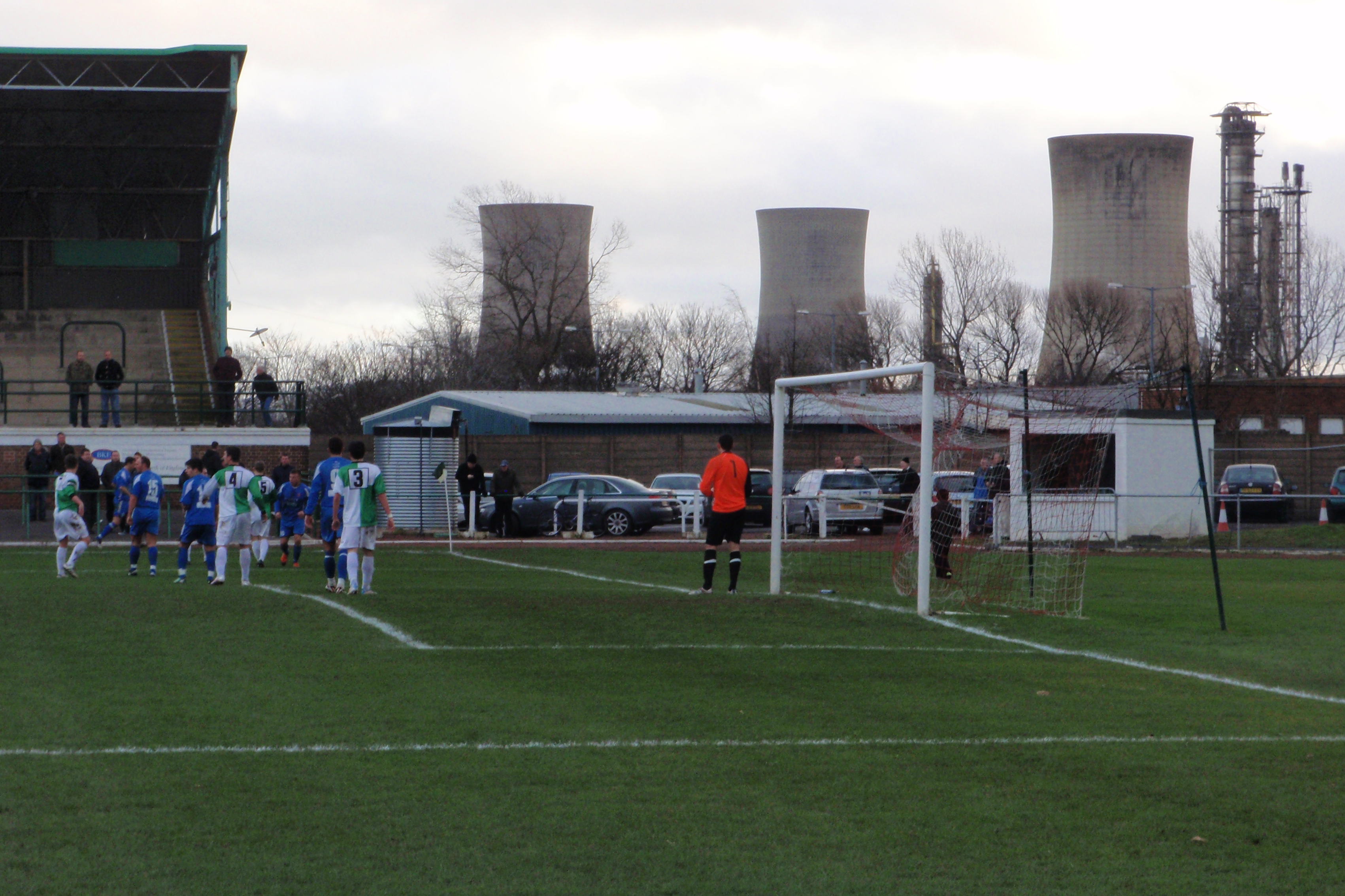
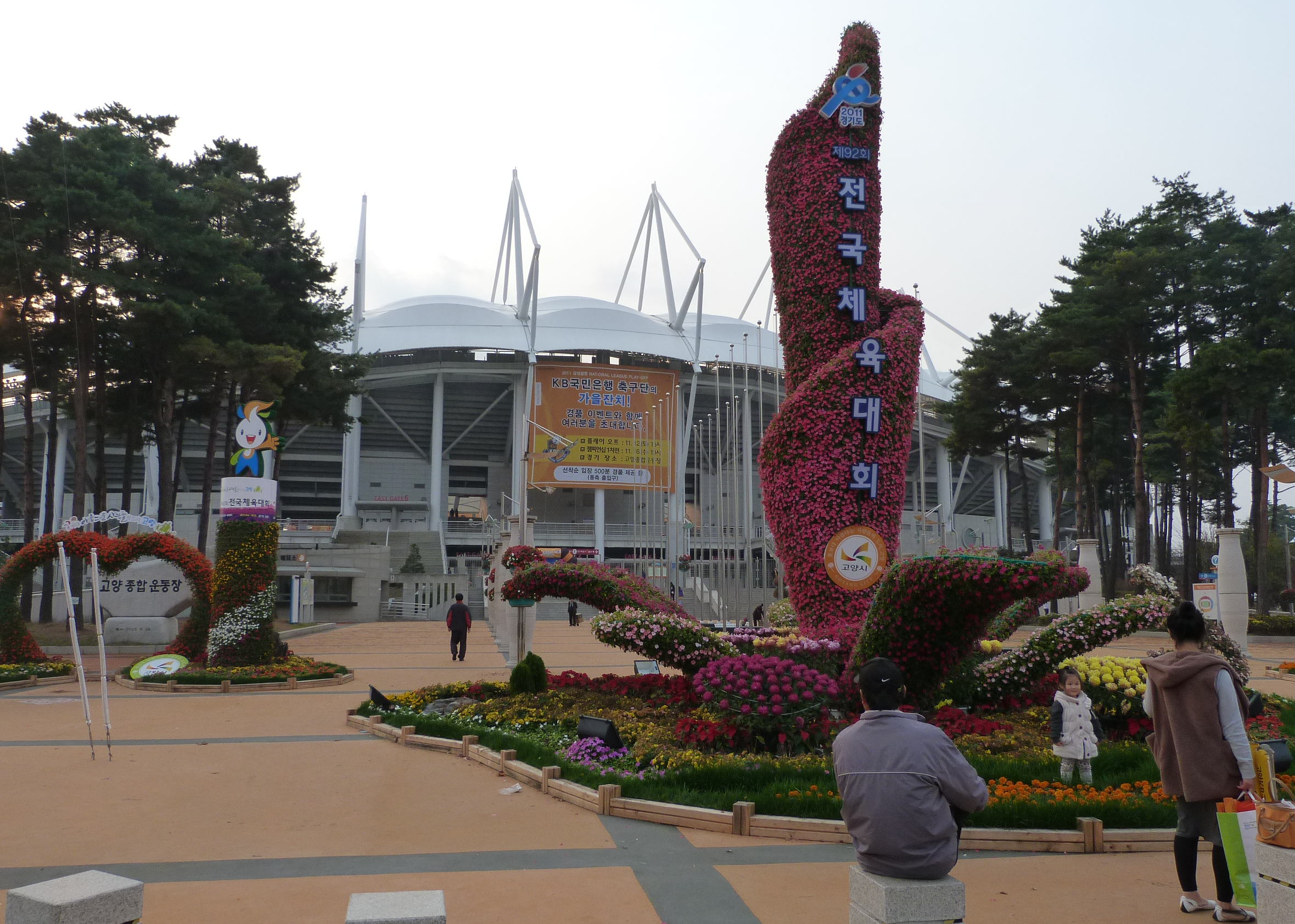
I doubt many architects would be able to tell the stadiums apart.

Goyang and Changwon had already progressed through one round of the play-offs and the winners of this tie would go on to face Ulsan Mipo in a two-leg final. We’d missed a couple of goals during our taxi ride but fortunately there had been one at each end and so the tie was nicely balanced.

There were probably about four or five hundred people inside the stadium, roughly double what you might expect at a National League game. Goyang had two sections of fans, some of them directly in front of Jen and I and a second lot behind the goal. It’s a shame when you have so few fans and they still divide into separate factions.

The 'behind the goal' lot.

The Changwon fans were probably the oddest bunch of supporters that I’ve seen whilst I’ve been over here. They looked as if they were on a pensioners day trip and had turned up here by mistake instead of at some farmer’s market or seaside town. Perhaps they saw the stadium in the distance and mistook it for a temple. They had a couple of cheerleading grannies who were dressed in traditional costume and who spurred the team on with a pair of cymbals and a gong. Even if they all had grandsons playing in the match, it still seemed a bizarre turnout for a team from five hours south.

"Get into them..."

As far as the action goes, Goyang took the lead with about fifteen minutes remaining when Kim Young Nam managed to bundle the ball home after his initial shot had hit the post. He looked a good player but I wasn’t too impressed with his attitude. He was trying too many flicks and backheels for the situation his team was in.

Goyang push for a third goal.

Changwon hit back two minutes from time when Lee Jung Hwan scored a cracker from outside of the box. That made it two apiece and took the game to extra time.

The home fans celebrate getting to see another half an hour of low level football.

Unfortunately, I had a flight to catch and so we couldn’t stay to see the outcome. I looked it up later and a Song Geun Soo own goal clinched the game for Goyang who will go on to play Ulsan Mipo in the final. I felt sorry for the busload of Changwon pensioners, but I dare say that every day out is a bonus at that time of life.

Moaksan hiking, Saturday 5th November 2011

November 10, 2011

Jeonbuk Motors had qualified for the Asian Champions League final and had been fortunate enough to be drawn at home. It’s a strange system, playing a one-off final at the stadium of one of the teams rather than a neutral venue. However, I’m not complaining as it meant that Jen and I could go to the game.

Kick-off wasn’t until seven in the evening and so we took advantage of the nearby Moaksan Provincial Park to do some hiking first. Moaksan is about twenty minutes and fifteen thousand won in a taxi from Jeonju bus terminal.

The street that leads to the start of the trail

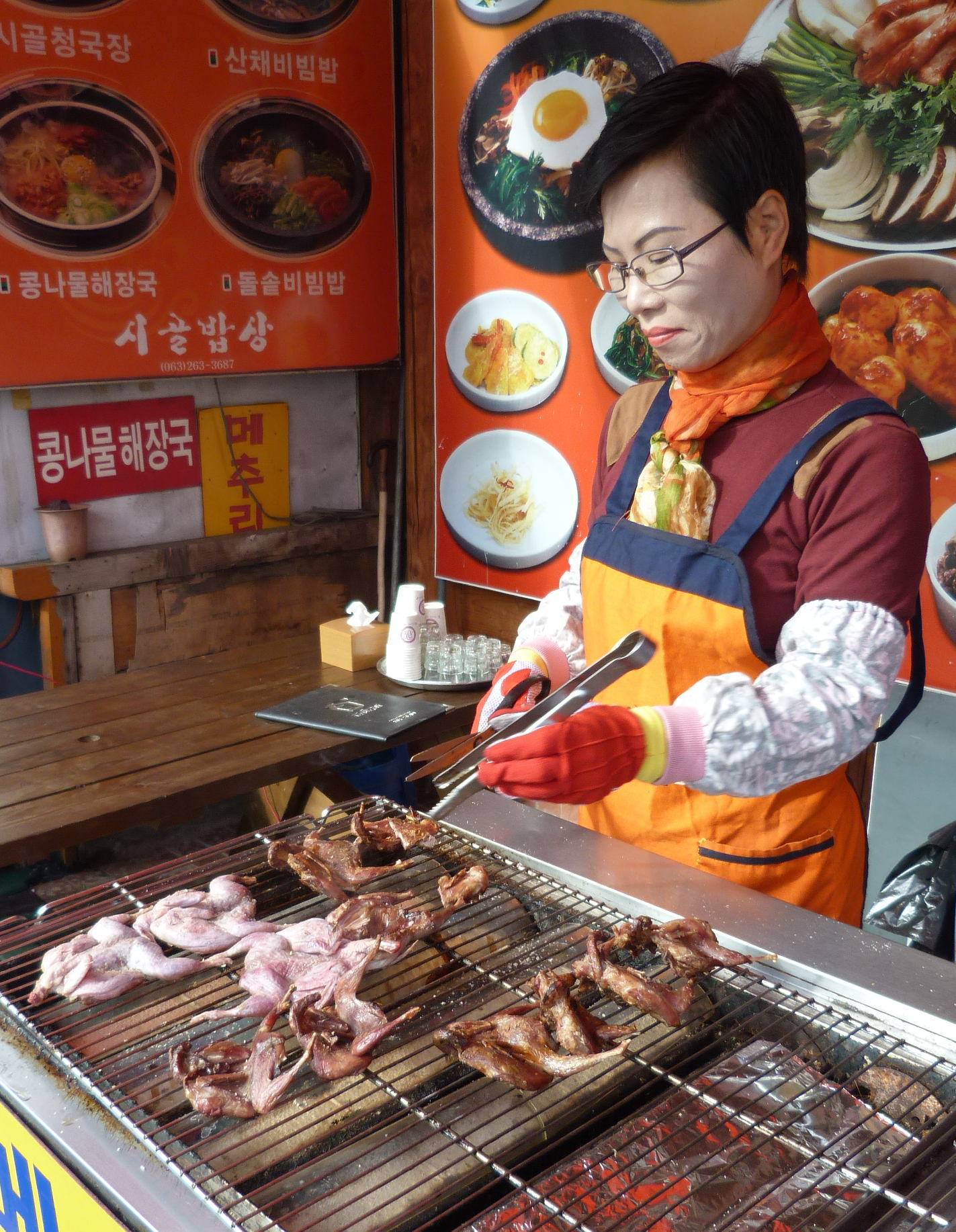
We got there for about half past nine, had some mandu and gimbap for breakfast at a small cafe and were ready to go by ten. There are plenty of shops and restaurants at the entrance to the trails, although I didn’t see any hotels. I’d be surprised if there weren’t any though.

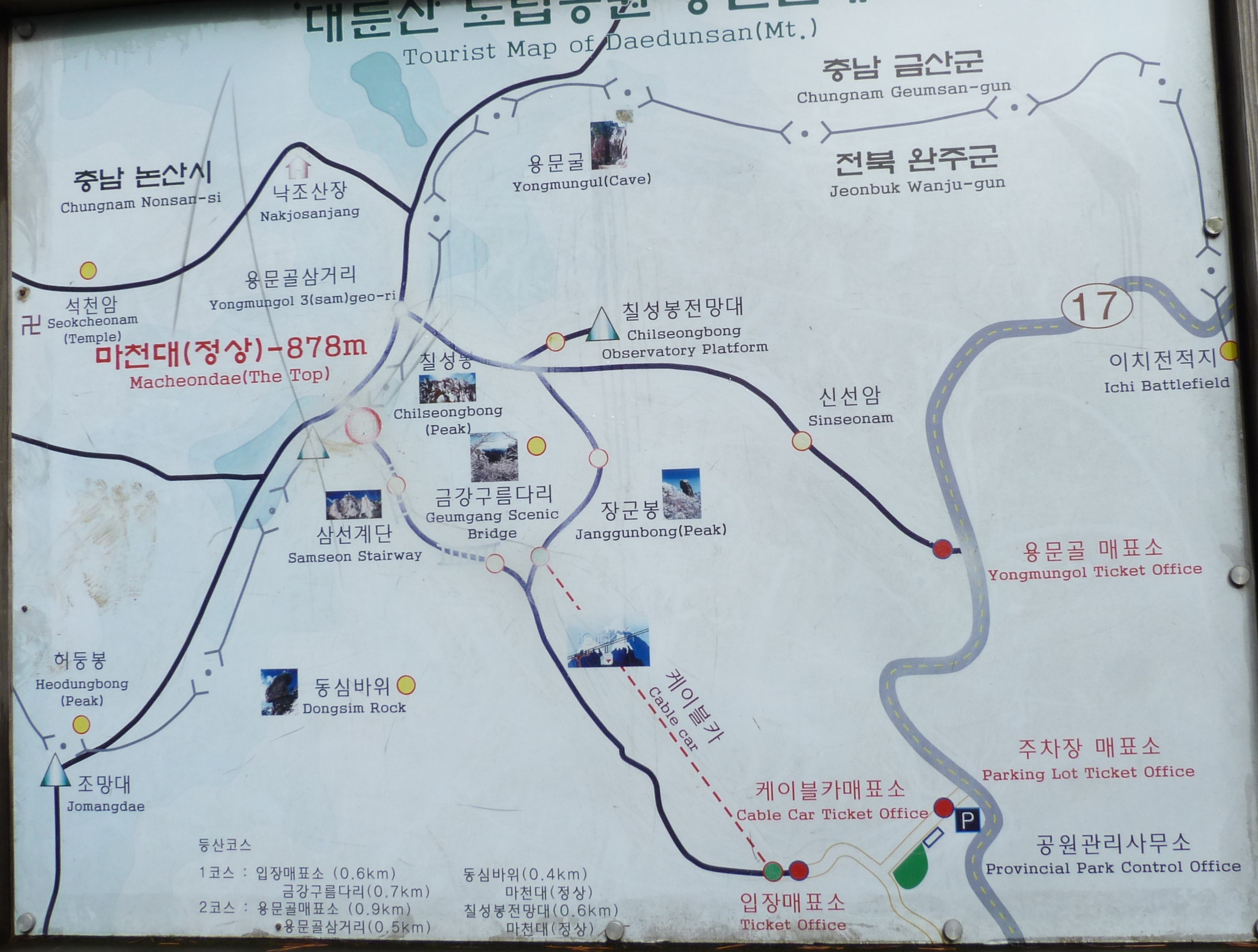
Moaksan map

The highest point in the park is Mt Moak at 793.5m. Quite why the half metre matters I don’t know. Possibly a neighbouring park has a hill that is only 793m high and Moaksan likes to highlight how much better its hill is. Anyway, there are three routes up Moaksan if you are starting from where we were. You can go straight up the valley or you can take a ridge route to the right or left. Most people were going straight ahead, so we went right. It’s slightly longer at 3.5km, but at that sort of distance it doesn’t really make much difference.

The views were obscured by trees and fog.

It was quite steep to start with, then we got a few stretches of reasonably flat trail followed by a couple of staircases. Two hours after setting off we were at the top. Or at least what we thought was the top. After staring into the fog for ten minutes and feeding a feral cat some of the left-over mandu that we’d saved for lunch we continued along the trail only to find the real summit a couple of minutes further along.

Nine out of ten feral cats prefer mandu

The actual peak was cluttered with military buildings and phone masts. Possibly some of the other people knew that it was there but didn’t think it was worth the effort.

At the top.

Our plan had been to descend via the back of the mountain but we took a wrong turning and ended up coming back down the ridge to the left instead. It was fairly steep, with some sections where you needed to hang on to a rope.

It's cheaper than building a staircase.

It took a couple of hours to make our way down to the bottom where we caught a bus from the car park back to Jeonju. I didn’t see a timetable so have no idea how frequently it runs. The seven kilometre walk that we did was ideal for a half day and our plan is to go back sometime when the visibility might be better and take the trail that we had thought we were taking this time.

Songnisan Hiking, Sunday 23rd October 2011

November 1, 2011

Jen and I had been to a football match at Cheongju on the Saturday afternoon and as Songnisan National Park isn’t too far away we decided to head there afterwards and do a bit of hiking. I’d been to Songnisan for a weekend earlier in the year and on the first day had taken the trail to Mungjangdae. I had planned to hike up to Cheonhwangbong the following day but there had been a lot of ice on the ground and a snapped crampon had prevented me from getting any further than half–way up.

Songnisan - Feb 2011.

In the autumn though, there is no need for crampons and so I took the opportunity to have another crack at the 1,058m Cheonhwangbong peak. We got the bus from Cheongju, arriving at Songnisan an hour and a half later at about 6pm. Last time I’d been there the place was deserted, most of the hotels and restaurants were closed and the main street looked like a ghost town. This time though the place was heaving with people. Unbeknown to us Songnisan was holding its ‘Festival of Falling Leaves’ which is an excuse for a couple of thousand people to descend upon what is pretty much a one street town to drink soju and eat pancakes whilst appreciating the surrounding foliage.

The consequence of all of this nature study was that hotel room prices had doubled. On the plus side though it did mean that there were plenty of places to eat. We didn’t watch much of the concert that was taking place at one end of the street, but we did have some seafood pancakes and dongdongju. If you’ve never had dongdongju, it’s like moonshine makgeolli. As makgeolli is pretty much moonshine anyway, that makes dongdongju a sort of moonshine moonshine. It was quite drinkable though.

It's not quite Glastonbury, but still a decent turnout.

Next morning we set off early and were in the National Park not long after eight o’clock. There were a lot of people milling around but fortunately most of them were either following the trail up to Mungjangdae or were content with visiting the big statue at Beopjusa temple near to the entrance to the park.

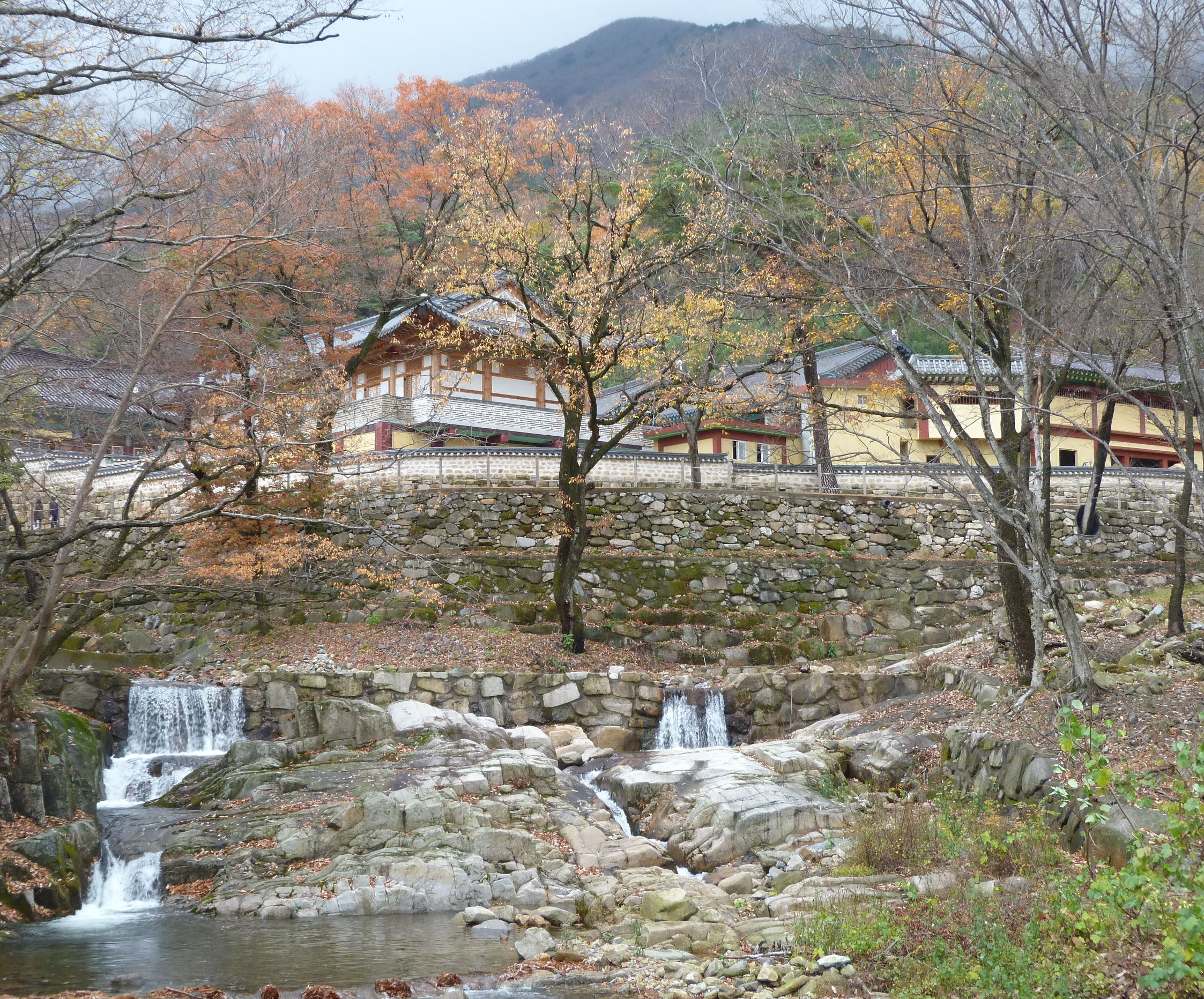
Beopjusa

The path up to Cheonhwangbong was fairly quiet, or it least it was for most of the way. As we got to about twenty minutes away from the peak we met the hikers who were doing a loop from Mungjangdae and those who had made an even earlier start than us and who were on their way down. This meant that the single file path became crowded to the extent that we had to keep stopping to let people coming down get past and those behind us who wanted to run to the top to get by.

We reached the peak after about three and a quarter hours and eight kilometres of walking. The first five kilometres had been pretty flat and we’d covered that section of the trail in about an hour, with the final three kilometres being pretty steep and taking the remainder of the time. There were probably about twenty people at the top when we arrived and there was barely room to sit down.

At the top of Cheonhwangbong.

We hung about for ten minutes or so looking down on the clouds and the surrounding mountains. If you could find a view that wasn’t obscured by a couple of Koreans gurning for the camera then it was worth looking at.

Above the clouds.

Because of the wet leaves on the ground the descent took almost as long as going up did and whilst it was easier on the lungs and muscles it was murder on my knees. We were back at the bus station for about quarter past two though and were able to catch the next bus to Seoul. They run every ninety minutes or so but you can’t pre-book them and once each bus is full it sets off. Our bus departed about twenty minutes before it was meant to.

Songnisan to Seoul bus timetable

So, I’ve hiked Songnisan with the crowds and I’ve hiked it when it’s covered in snow and ice. I think I’d like to try to make my next visit sometime when it’s quiet but solid underfoot. There’s probably a three-hour slot sometime on a Wednesday afternoon in April when it might just be like that.

Jeju Olle Trail – Route 7, Sunday 25th September 2011

October 8, 2011

The Jeju Olle Trail is a series of hiking paths that mainly follow the coast around Jeju Island. I think that there were initially twelve routes that totalled over two hundred kilometres, but it seems that as more villages want to get in on the action there are now over twenty different routes. The intention looks to have been to try to divert hikers from the popular hikes up and down the 1950m Hallasan and to give some of the coastal areas a bit of a tourism boost.

The previous day Jen and I had walked the 15.6km route 7-1 from Oedolgae Rock to the World Cup Stadium and as we were staying in the area we thought we might as well return to Oedolgae Rock and hike along route 7 to Wolpyeong.

It’s a short taxi ride from Seogwipo to Oedolgae Rock. Most people arrive by coach though as part of a touring party to visit the location where one of the characters in a television soap opera died. A lot of the visitors had apparently come all of the way from Japan and China just to stand and gawp at a rock because it had briefly been on the telly. Although I suppose they may very well raise an eyebrow at the idea of me travelling six thousand miles to Korea and then watching third division football. Or wandering around an empty stadium if there isn’t a game on.

The monk on the right found a bit of peace and quiet.

The crowds disappeared after the first few hundred metres and there were a lot of wooden walkways in this early section, so it didn’t take too long to cover the first few kilometres. It’s generally as scenic as you’d expect a coastal walk to be with plenty of cliffs, beaches and, due to it being a bit warmer than the rest of Korea, lots of palm and orange trees.

Slightly out of step with the rest of the walk though is the section where the route passes through a sewage disposal plant. I was a little surprised that the trail hadn’t been diverted to detour around it.

I didn't get a photo of the sewage works, so here's one I took of a dog instead

An hour and a quarter into the walk and we reached the World Cup Stadium, or at least the crossroads where you could leave route 7 if you wanted to go to the match. There wasn’t a game on so we just carried on. That’s twice we’ve seen the stadium now without getting to see a match there.

You can just about see the roof.

Some of the fishing villages that we passed through looked as if they hadn’t changed much in years, apart from signs in restaurants advertising their Olle Trail Specials and an occasional newly opened coffee shop. At one place we saw women washing clothes by hand in the seawater.

"Tide's in, dirt's out."

At others there were women bundling and bagging seaweed. I’m not too sure what the blokes were doing whilst all this was going on.

The bags weigh 50kg each.

There were plenty of stalls along the way selling food and drink so you could leave the backpack at home if you wanted. You could buy a box of oranges if you fancied, or just a slice of pineapple.

I felt like the man from Del Monte.

About two-thirds of the way along we passed a site intended for a new naval base. It looked as if the locals were none too happy to have had their land used and there was a peace camp protest, a large police presence and plenty of slogans in both Korean and English painted on the perimeter walls of the base.

I doubt that you would see that North of the border.

It took us just over four hours to complete the 15.1km route to Wolpyeong. There isn’t a great deal at the end apart from a small shop and a fish restaurant. We called in and got some soup and a raw mackerel. The mackerel was fresh from the tank and at one o’clock it looked like this.

Does that count as 'freshly caught'?

Ten minutes later it looked like this;

Served raw - eat with a bit of rice and spicy sauce wrapped in seaweed.
We were fortunate to be able to get a taxi back to Seogwipo afterwards as I don’t think too many cabbies would tend to hang around at the end of that particular Olle route. There was enough going on in Seogwipo to fill in the rest of the afternoon and we took a ride in a submarine to a depth of about fifty metres and then had a walk along to a waterfall.

We were sat just behind the driver.

Both were interesting enough. Disappointingly the submarine didn’t make that sonic beeping noise that they do at the pictures, instead we got some relentless babble in Korean from a crew member who fancied himself as a bit of a comedian. The waterfall was busy but worth the effort too.

It takes a while for the new fashions in Seoul to reach Jeju.

We’ve got plans to do a few more sections of the Olle Trail. With the exception of the start where we encountered the coach-trippers there weren’t many people about and so out of season it should be even quieter. I doubt that we’ll get around all of the trails but with there being not too many hills I think it’s quite possible to do two routes in what would be a 30km day. We’ll see.

Jeju United v Jeonbuk Motors, Saturday 24th September 2011, 3pm

October 3, 2011

I’ve been waiting a while to see a game in Jeju. Its island location means that a bit more effort is required to get there than most places. If Jeju United had managed to hold on to top spot in the league at the end of last season then I’d have seen the Championship play-off there. Unfortunately they slipped to second and I had to reschedule our flight tickets for a couple of months later when the season was over.

My plan this season had been to time my trips to those stadiums that I had yet to visit to coincide with the home team’s fixture against Lee Dong Gook’s team, Jeonbuk. It had worked well and Jeju was the final K-League destination on my list. That’s not to say that there won’t be other top division grounds for me to see over here; Incheon will move to a new home next season and I’d like to think that Daegu will return to the World Cup stadium now that the World Athletics Championships has finished.

Jen and into flew into Jeju International Airport on the last flight out of Gimpo on the Friday night. It wasn’t the best of journeys as the taxi ride from Yeoksam to Gimpo had taken us almost twice as long as the hour-long flight. I tend to smirk a bit when I see that an airport feels the need to include ‘International’ in its name. I think it just makes the place look small-time.

A much quicker taxi ride took us to the southern part of the island and the town of Seogwipo where we got a hotel in what appeared to be the only street that the bloke from the Lonely Planet Guide had visited.

Next morning we were up and out early as our plan was to walk to the game along one of the sections of Olle trail. It was just over fifteen kilometres long and it conveniently finished at the World Cup Stadium. I like walking to the match, I used to do it as a kid at Ayresome for financial reasons and still occasionally walk to the Riverside from Norton when I’m back in the UK. As I can afford the bus fare these days, I’ve been forced to conclude that I do it because I’m a bit odd.

Jen and I walked for four hours to a Seongnam game earlier in the year and then made an unfortunate effort to do the same for a Seoul game only to be thwarted by the floods after six hours. This time though it was quite straightforward, or at least it should have been. The Olle trail is generally well-marked but as we were doing it in the ‘wrong’ direction, starting from Oedolgae Rock, some of the signs were less noticeable.

Oedolgae Rock

We soon got lost and missed out some of the early sights, although we did pass a small football ground and an indoor croquet facility that was big enough to house aircraft in. I’ve no idea if croquet is, like snooker and darts, one of the sports that as host nation we will be adding to the 2012 Olympic event list. What I can be sure of is that we won’t have an indoor croquet facility anywhere in the UK that is even half the size of this one. I sense another banker gold medal slipping away.

I think our Olympians have the odd game in the back garden on a sunday afternoon.

We picked up the official route again after about an hour and a half and I reckon our short cut had probably knocked a couple of kilometres off it. Most of the Olle trail just follows the coast around Jeju and so there aren’t too many hills to deal with. The section that we were hiking (7-1) loops inland though and takes in the 396m Mount Gogeun.

I know that 396m does nt seem much, particularly when it is in the shadow of the 1950m Hallasan, but it was a decent slog up the last stages and would have been much more strenuous if we had done the walk the ‘right’ way around.

Hallasan viewed from Gogeunsan

As we came down the other side we got our first view of the World Cup Stadium. It’s an impressive sight with a roof on one side that curls around behind both goals.

Jeju World Cup Stadium

It didn’t take us long to walk into town and complete the section of Olle trail. After posting ourselves a box of Jeju tangerines, we had a lunch of pig bone soup. It was ok, possibly due to it coming with the first beer of the day.

We finally rolled up at the stadium with about forty minutes to kick-off. It was pretty quiet outside and I was a touch scathing about the lack of fans, particularly as Jeju United had been relocated from Bucheon a few years ago in a team-stealing move that puts MK Dons to shame.

We couldn’t find an open ticket office or entrance gate, but eventually got in via a museum. When I looked at the pitch I realised the reason for the lack of fans. The grass was long, there weren’t any markings and there weren’t any goal nets.

2.35pm and the groundsman still had a fair bit to do.

A quick chat with a couple of stadium employees confirmed that the game was actually scheduled to take place forty kilometres away in Jeju City. We hopped in a taxi and retraced the journey that we’d made the previous night, arriving some forty minutes later and thirty minutes after kickoff. It took us another ten minutes to find the ticket office and buy our five thousand won tickets and so it was five minutes to half time before we finally saw some football.

That big banner says that the match is here and not at the other ground. Thanks.

The first thing that I noticed was that Lee Dong Gook wasn’t playing. He’s been having a very good season with nineteen goals in all competitions, so my presumption was that Jeonbuk were saving him for the finely balanced mid-week Champions League fixture with Cerezo Osaka. Or perhaps he’d gone to the wrong stadium too.

The game was goalless when we arrived, a scoreline that probably suited Jeonbuk better than Jeju. Before this fixture the visitors were eight points clear at the top of the league with just five games remaining. It would take a disastrous collapse for them not to finish top and secure home advantage in the Play-off Final. Jeju were on the edge of the play-off places and really needed more than a point if they wanted to be involved in the post-season games.

The view from where I was sat.

There weren’t too many fans inside the ground, perhaps the venue change had confused a few other people too. I’d reckon on about three thousand, with Jeonbuk and their Mad Green Boys contributing about eighty of them. The Jeju Ora Stadium holds twenty thousand people, so it did look fairly empty. It’s about forty years old and a typical ‘bowl’’. There’s a running track and a small roof down one side.

Not so mad, they did at least get to the correct stadium.

The Lion King came off the bench ten minutes into the second half, replacing Luiz Henrique. After an initial spell playing a bit deeper than normal he moved further forward when Lovrek was subbed a few minutes later.

Time for a change.

Jeju hit the post on the hour from a free kick just outside the box and the Jeonbuk keeper made a good stop ten minutes from time, standing up well to a shot from a tight angle after a quick Jeju break.

Both sides had chances in the last few minutes but neither were able to break the deadlock and it finished goalless. We hung about for a few minutes to see if we had won a car in a raffle, although it would have been a hassle to get it back to Seoul. Maybe we could have got them to post it like the tangerines.

Whilst it was a bit disappointing not to see a game at the World Cup Stadium, there’s always next season and it did give us the opportunity to visit a ground that I hadn’t expected to get to. The point reduced Jeonbuk’s lead at the top of the table to five points, with just the four games to go.

Hiking at Geumosan, Sat 3rd September 2011.

September 14, 2011

The World Athletics Championships have been going on in Daegu for the past week and Jen and I had tickets for the final two days. There’s a handy Provincial Park with some decent hiking just outside of Daegu at Palgongsan, but we had already been there a few months back. There’s another Provincial Park, Geumosan, about half an hour away on the train though and as the athletics took place in the evenings we decided that we might as well stay near to Geumosan and do some hiking there during the day.

We took the KTX from Seoul to Daejeon on the Friday night and then switched to a Saemaul train for the remainder of the journey to Gumi. Saemaul is the first step down from the high-speed KTX. They are a bit slower but still quite posh with velvet seats and plenty of room. I was quite impressed, although I had been drinking and stuff often seems better then.

I have a suspicion that a reasonable proportion of the readers of this blog who visit here intentionally rather than those who stumble across it after a search for ‘Penis fish’, ‘Gorilla autopsy’, ‘The Olsen Twins’ or the occasional combination of all three, may very well be the sort of people who have an interest in things like trains. With that in mind, I took a photo of the inside of the carriage.

One for the rolling stock enthusiasts.

We got to Gumi at about half past ten and checked into the Metro Motel which was pretty much the first place that we found. It was either the poshest place in Gumi or the most delusional as it had Won to Yen exchange rates displayed in its foyer to cater for Japanese tourists. I couldn’t help but wonder why on Earth someone would travel from Japan to holiday in Gumi. The most noteworthy thing I could find out about the town was that a fair bit of public money had been ploughed into the local industry at around the same time that a local boy became President.

For the benefit of any Japanese tourists, that's it. Behind the shops.

Mind you, I was back in Stockton recently and there were loads of people on holiday there which baffled me. Not many Japanese I suspect though. Not unless they were international Pound Shop aficionados.

Next morning we took a five minute taxi ride to Geumosan and walked along a trail which followed the road for a while. The path slowly gained height until we reached a sign that pointed out that the 976m summit was 3.3km away and from then on it became much steeper. It was a steady slog up stone steps for over a kilometre until we reached a temple with an odd looking Buddha.

Nice looking temple though.

Another hundred or so yards up some more steps and we reached a waterfall. It would have been a lot more spectacular in the rainy season, but at twenty seven metres high it was still worth pausing for a closer look.

It was worth pausing for a rest as well.

At this point there were still over two kilometres to go to the top and we resumed with a few flights of stairs. Whilst this was easier than the less uniform stone steps, it did, at times,  just feel like a trip to the gym rather than a walk in the hills. Not that I’m overly familiar with gyms. The steps soon gave way again to a more natural trail, but it was still a relentless grind uphill. We had one stretch of flat walking that lasted about twenty yards and that was it.

The views were magnificent though. Normally the trees obscure just about everything until you reach the top of the hill. Sometimes they still block your view even then. We got a good look outwards towards and beyond Gumi from a couple of points two-thirds of the way up.

Gumi - It looks better from a distance.

With less than a kilometre to go we finally got a flattish stretch of a couple of hundred metres. It was soon back to the slog though for the final section where we were rewarded with a summit littered with mobile phone masts, tin huts and assorted military equipment. The views were crap too.

Time for another sit down.

A slight detour down a different route took us to a temple where the scenery was a lot better and gave us the opportunity to use the monk’s toilets. Oddly, there weren’t any wash basins which leads me to conclude that monks probably don’t wash their hands afterwards. That won’t get them into heaven even if they do get out of bed early to say their prayers. We went back down via the route that we had come up and it wasn’t much easier on the legs descending. Five and a half hours and eight kilometres after setting off we were at the bottom looking for a taxi to take us back into Gumi. My calves still ached four days later.

Hiking at Gwanaksan, Saturday 6th August 2011.

August 25, 2011

I had big plans for this weekend, well big plans if you like watching lower level football I suppose. In addition to the National League game at Chungju on the Saturday, Jen and I had been planning on going to the Challengers League Cup tournament on Sunday. It’s a competition for the third tier teams played over the space of a week in the one town, Jecheon on this occasion. There were seven games scheduled for the Sunday, spread over two stadiums. The winners of each match staying on until mid-week for the next round whilst the losers presumably clear off back to their holidays.

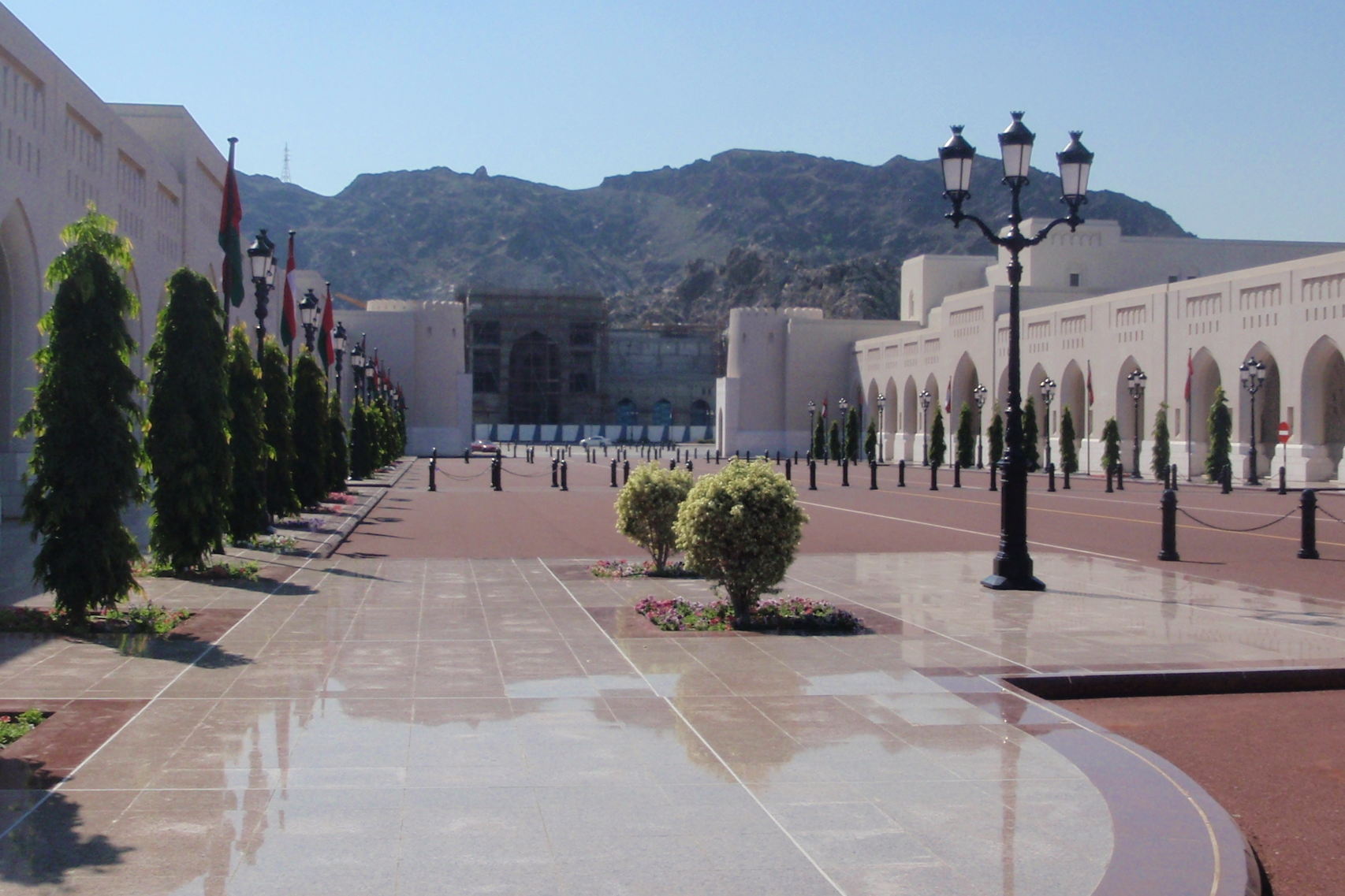
My job doesn’t usually interfere too much with my hobbies, not outside of normal office hours anyway, but unfortunately I had to go to a meeting in Oman and my flight departed just before midnight on the Saturday evening. That meant if we were going to do anything on the Saturday then it had to be Seoul-based and there wasn’t any football going on.

There are plenty of hills within the city though and so we decided to have a walk up Gwanaksan. There are a few different trails and a highest peak of 629m. Best of all, it’s only five subway stops from our apartment. If you are going for a walk though, you might as well just go for a walk and so to get there we followed the route of Line Two of the subway above ground from Yeoksam to Sadang. It took us about an hour and forty minutes to walk the subway line and then another twenty minutes or so to find the start of the trail once we’d got to Exit 6 of Sadang station.

It was worth avoiding the subway, mainly because we walked past some baseball cages where if you put a couple of five hundred won coins into a slot a machine fired baseballs at you at speeds varying from 100km/hr to 140km/hr. As I’d never played baseball before I naturally selected the fastest cage. Well, you would, wouldn’t you? After all, my first ever curry as a teenager was a Phal and whilst my mates cried with laughter, my eyes streamed with tears as the heat of the spices prevented me eating more than a quarter of it. For those of you who don’t know, a Phal is a like a Vindaloo, but with two tablespoons of extra gunpowder.

Another one flies past.

I’m not really one for learning lessons though and the first 140km/hr ball passed me before I’d even started my swing. As did the next few. I adjusted a little and eventually hit some of them, the best of which would probably have been caught somewhere near first base whilst the rest varied between being knocked into the ground near my feet or glancing off my bat into the fence behind. Fortunately none of them smacked me in the chops as I don’t think I’d have fancied arriving in Muscat the next day minus a few teeth. Whenever I’ve seen people in these cages they are usually half-pissed after a post-work drink with their colleagues, so maybe it’s one of those sports like pool and darts where a few beers improves your skills.

At Sadang station there was a line of old blokes awaiting the arrival of free food organised by a charity. As I stood around I was twice asked by locals if I’d like to join the queue. Perhaps it’s my age, maybe the way I dress, but I obviously looked a bit like a worthy recipient. We’d packed a bit of a picnic though, so I left them to it.

When we got to Gwanaksan, we followed the signs for Yeonjudae. It was a bit of a slog at first with very few sections were you could walk on the level. There’s an area about half an hour into the hike where you can replenish your water bottles, lift a few weights or hang upside down from a bar like a bat. It was a warm day so we settled for a drink of water.

There's plenty to do for those not tired enough by the hiking

We continued upwards for another hour and a half or so, stopping to look down on Seoul every time there was a decent view. It’s amazing how close we were to the heart of the city. The trail was very crowded, probably I suspect, more with people just happy to get out in the hills on a day when it wasn’t raining rather than with those who were prevented by work commitments from going to obscure football games in even more obscure towns.

My office is out there somewhere.

We didn’t get to the top. It’s one of those where the actual peak is fenced off because it sites some sort of communication tower and there didn’t seem a lot of fun in hauling ourselves up ropes and chain ladders in the final stages just to be able to reach a fence. We took a different route down, slightly longer at about four kilometres and one that mainly follows a river. There were plenty of people taking advantage of the cold water to cool down and I did the same.

I could have done with this during the Phal all those years ago.

We didn’t see much in the way of wildlife, a couple of cats and a dog with bright pink feet. I suppose for all it’s a hill, it’s still in the city. As we approached the end of the trail it got even busier with lots of families picnicking by the water. One couple were actually sat in the river whilst playing some sort of board game.

It's your birthday. Collect £10 from each player.

We emerged near to Gwacheon subway station and after initially hopping on a bus going in the wrong direction ended up taking a taxi back to Yeoksam. Overall we probably did about thirteen kilometres in six and a half hours. That doesn’t seem like much of a pace, but when you stop to play baseball or dangle your feet into a river that’s how long it takes.

Gwangju FC v Jeonbuk Motors, Saturday 16th July 2011, 7pm

July 27, 2011

A new team was added to the K-League this season, Gwangju FC. Their inclusion took the number of teams in the top division up to sixteen and had the benefit not only of increasing each club’s league fixtures to thirty but also of removing the problem of someone having a blank weekend due to the odd number of clubs.

Up until the end of last season the army team played in Gwangju as Gwangju Sangmu. They’ve moved to Sangju now though and as you might have guessed have been renamed as Sangju Sangmu. Their relocation meant that the Guus Hiddink Stadium no longer had a tenant and so Gwangju FC was formed and they moved in quicker than squatters in the rain.

I’ve been to Gwangju a few times, including seeing Gwangju Sangmu play in the Guus Hiddink Stadium, but as I haven’t yet seen the new Gwangju team I thought I’d better pay the place another visit.

Jen and I caught the KTX from a drizzling Yongsan on the Friday evening. It takes about three hours to get to Gwangju and it made a nice surprise to find that we’d gone beyond the rain clouds. We turned right out of the station and just picked the first hotel that we came to.

Complete with spires, towers and stuff.

It was good value at thirty thousand won a night with air conditioning, a large fan and, as advertised outside, a 42″ telly. We didn’t watch too much tv, but we certainly got full value out of the air conditioning as it ran all night on the ‘ Just like the inside of a fridge’ setting. I suspect that if we’d stayed there longer than a couple of nights then we might have bankrupted the hotel and created an energy shortage across the country.

It still wasn’t raining when we woke up, which is an unusual state of affairs for Korea at the moment. We couldn’t waste a dry day and so got a taxi to the nearby Wonhyosa Temple in Mudeung Provincial Park. It only took  twenty minutes and even with a bit extra added on to the meter price in compensation for the lack of a return fare it was still under fifteen thousand won.

The various trails were reasonably well signposted, but we still managed to take the wrong route initially and had to retrace our steps. There was plenty of wildlife to see though, including chipmunks, frogs and a dog with pink ears.

There are packs of them, running wild.

There are a few peaks higher than a thousand metres in the Mudeung Provincial Park, although not all of them are accessible. We walked for about six hours in total, covering sixteen kilometres or so. The peak at Seoseokdae looked to be blocked off but we got as far as the 1,100m Ipseokdae rocks on Mudeungsan after stopping off for a while at a temple on the way up to Jangbuljae.

On the way down from Ipseokdae

After getting back to where we’d started from at about quarter past four we were fortunate enough to be able to quicken our stride and catch the bus just as it was about to leave. It wound around town for a while but still had us back to Gwangju Station within forty minutes.

Gwangju’s home game with Lee Dong Gook’s Jeonbuk Motors was due to start at seven o’clock and by the time we’d got changed and taken a taxi there was only half an hour to go until kick-off. We got a couple of tickets at ten thousand won apiece and were given a free bottle of water and can of Sprite each as we went in. We had tickets for the West Stand, but as they didn’t have any turnstiles open we had to enter via the North and make our way around.

Lee Dong Gook was starting up front for Jeonbuk, with the Brazilians Luiz Henrique and Eninho in attacking midfield roles. We got the “No, nay, never, no nay never no more, will I play the fixed odds, no never no more” speech from the captains before the start again. I wonder how long that is going to have to go on for.

"I think I'll have the chicken and chips please"

In the first half most of the action took place off the pitch. The home fans unfurled a banner after ten minutes or so that had the stewards scurrying over to remove it. There was a bit of scuffling as both sides fought over the banner, with the fans heavily outnumbering the stewards. Eventually though the banner came down.

Behind the home goal

Fifteen minutes later it all got a bit livelier as around forty of the fans behind the goal made their way around to the main stand and started shouting at the club officials. A few of them were pretty angry and this led to fans from the main stand remonstrating with them. It all got a bit heated with a few punches thrown. There wasn’t a copper in sight though and as more of them arrived the stewards could do little to disperse them.

Sod off, sonny.

After ten minutes or so the ringleader decided it was time to take his army of teenagers and social misfits back behind the goal. They received plenty of abuse on their way back from some of the older fans, but seemed quite pleased with their little adventure. I find it all a bit sad that people can get worked up at a football match to a level of rage that turns to physical violence, particularly over a team that hadn’t even existed five months previously.

Nothing of note happened in a goalless first half and at the interval Jeonbuk took off their two Brazilians, replacing them with Kim Dong Chan and Krunoslav Lovrek. The substitutions didn’t have the desired effect though and it was Gwangju who took the lead ten minutes into the second half with Lee Seung Ki sliding the ball home at the far post.

1-0

Gwangju didn’t hold on to their lead for long though and a few minutes later a cross from the left took a deflection off home defender Kim Su Beom for a scrappy equaliser.

We didn’t get any more protests and we didn’t get any more goals. The draw took Jeonbuk four points clear at the top of the table, ahead of second placed Pohang Steelers who had lost at home to Chunnam Dragons.

Kia Tigers v Hanwha Eagles, Sunday May 22nd 2011, 5pm

May 26, 2011

After the match between Asan Citizen and Seoul Martyrs I caught the slow train to Gunsan. It wasn’t quite as slow as the subway journey that I’d taken earlier in the day but I still spent over two hours looking out of the window at rice fields whilst the train stopped at every one-ox village on the way.

Jen had been to a baby shower in Seoul that afternoon, astonishingly preferring it to watching a third division game in the rain. She set off to Gunsan once it was finished though and I met her at the bus terminal. We asked a taxi driver to just take us to where it was busy and he dropped us off at an area not too far from the coast and with a few bars and restaurants. It was all still fairly quiet for a Saturday night though.

Next morning we went for a walk around Wolmyeong Park. There are a few miles of different trails, some of which will take you up to the tops of smallish hills, none of them bigger than about 150m.

Wolmyeong Park

There were plenty of large carp in the lake that we fed chocolate to and on the way up to one of the hilltops I had a go on some of the exercise equipment. It didn’t look as professionally made as the stuff I’ve seen elsewhere in Seoul, but looking on the positive side I doubt that it weighed as much.

It's heavier than it looks.

As it got towards mid-afternoon we got a taxi to Gunsan Baseball Stadium, thinking that it wouldn’t do any harm getting there early. If you are going to drink beer in the sunshine, there’s no reason why you can’t start before the match does. When we arrived, we were a little surprised to discover how crowded the area around the stadium was despite there still being two hours to the first pitch.

The teams had recently arrived and a lot of people were taking the opportunity to get their shirts signed.

He seems a popular lad.

Kia Tigers play most of their games further south in Gwangju, but stage nine matches in Gunsan over the season. It’s a smaller stadium and obviously a big deal to the locals when the baseball comes to town. Jen went to get the beers whilst I joined the queue at the ticket office. It took me half an hour to reach the front, where I was able to get 8,000 won tickets that allowed us to sit anywhere apart from a small covered section directly behind the plate.

Still two hours before the game started.

Despite the mayhem outside, it was still fairly quiet inside the stadium at half past three, although lots of the seats had already been reserved by people for their friends who were yet to arrive. A block of maybe twenty seats next to where we sat were marked as taken with tubes of Pringles or other snacks. By the time the game started there were very few empty seats and people were sitting in the aisles and standing at the back.

And not just people.

Kia seemed the team most likely to score although neither side broke their duck until the fifth innings. Hanwha starter Yang Hoon got the hook soon after conceding a couple of runs but unfortunately for the Eagles it quickly got worse with his replacement being hit for another four runs in the few minutes he was on the field.

Hanwha pitching to Kia, with the home fans in the background.

Yoon Seok Min fared better for the Tigers and by the time he was withdrawn in the sixth innings without having conceded a run the game was won.

Yoon Seok Min about to pitch for Kia Tigers.

We left not long after seven o’clock as we had a train to catch. The Tigers sent the locals home happy a little later with an eventual 13-1 victory. Next week we’ll be seeing Kia at their other ‘home’ stadium in Gwangju where they will be taking on Lotte Giants, the team whose fans blow up supermarket carrier bags and wear them as hats. Really.

Palgongsan hiking, Saturday 14th May 2011.

May 19, 2011

At the weekend Jen and I visited Palgongsan Provincial Park. We were going to watch Jeonbuk play away at Pohang Steelers on the Sunday and thought that if we took the train south on the Friday night after work, we’d be able to get a day’s hiking in on the Saturday.

It all went very well. The 8.30pm KTX from Seoul got us into Daegu just over an hour and a half later and we then got a taxi for the twenty kilometre drive to Palgongsan. We had been planning on staying in the Hot Springs Spa but they had no rooms for the Saturday night. Instead we ended up in the Ivvy Motel just around the corner. That’s right, Ivvy with two vees.

We got a very large room for 50,000 won per night. All of the Love Motels in Korea are designed to help guests retain their anonymity by not requiring you to give any registration details, but this one took it to another level. If you have a car, you drive into your individual garage where you can lower the door behind you to avoid your car being seen. Then you climb the stairs to your room where you access it by feeding banknotes into a machine in the wall. There wasn’t even a key because I don’t think anyone is expected to leave the room until they check out. It was well equipped with two bathrooms, two large screen tellies and mirrors over the bed. There was even a beer in the fridge. Oddly though, there wasn’t a door on the toilet.

Next day we had breakfast at a table outside of a GS25 convenience store and then made our way up the trail.

I'm told it's what proper mountaineers eat.

There were a variety of routes and we decided to head for the 1,167m Dongbong peak. The trail was relatively quiet by Korean standards and a couple of hours later we were at the top. There were some decent views to what I think was the North.

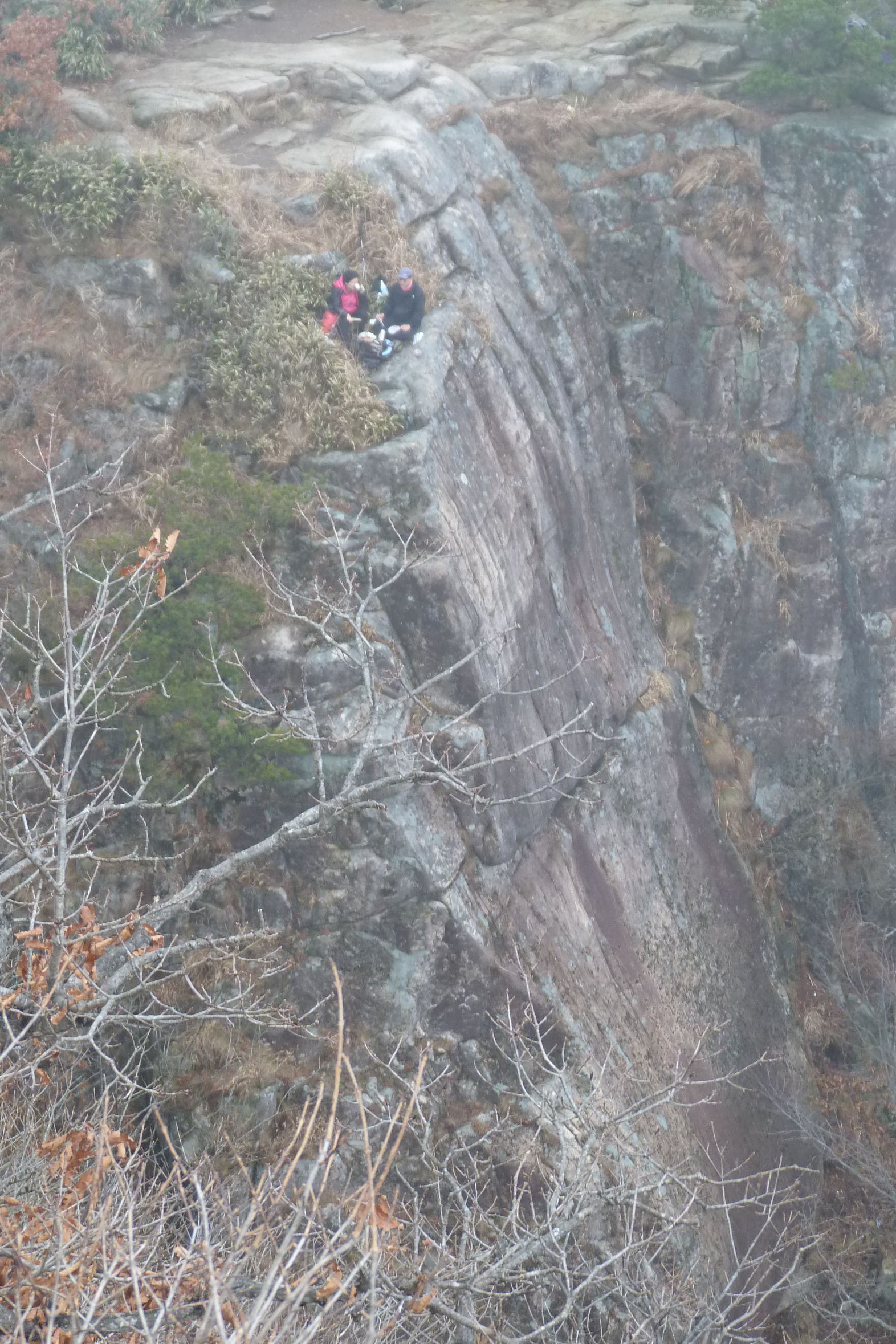
Those people were having their lunch.

To the West there was the bizarre sight of a golf course set into the hillside. It really did seem such an odd place to build it. I’ve not played much golf, but random courses where you least expect them is something that might just inspire me to take it up.

Palgongsan Golf Course.

We didn’t really have much of a plan for where to go next and set off towards Gatbawi. There are a couple of quite famous Buddha statues there and so it seemed as good a place as any. The route was quite hard work though with lots of sections where you had to lower yourself down on a rope or by using the railings.

After a while we decided to head for Donghwasa Temple instead. One Buddha statue is as good as another as far as I’m concerned and the route looked to involve a bit less clambering about. We got lost part of the way down as we were using a trail that wasn’t marked on the maps, but after stumbling across a different temple we managed to find our way to Donghwasa.

Buddha statue at Donghwasa Temple.

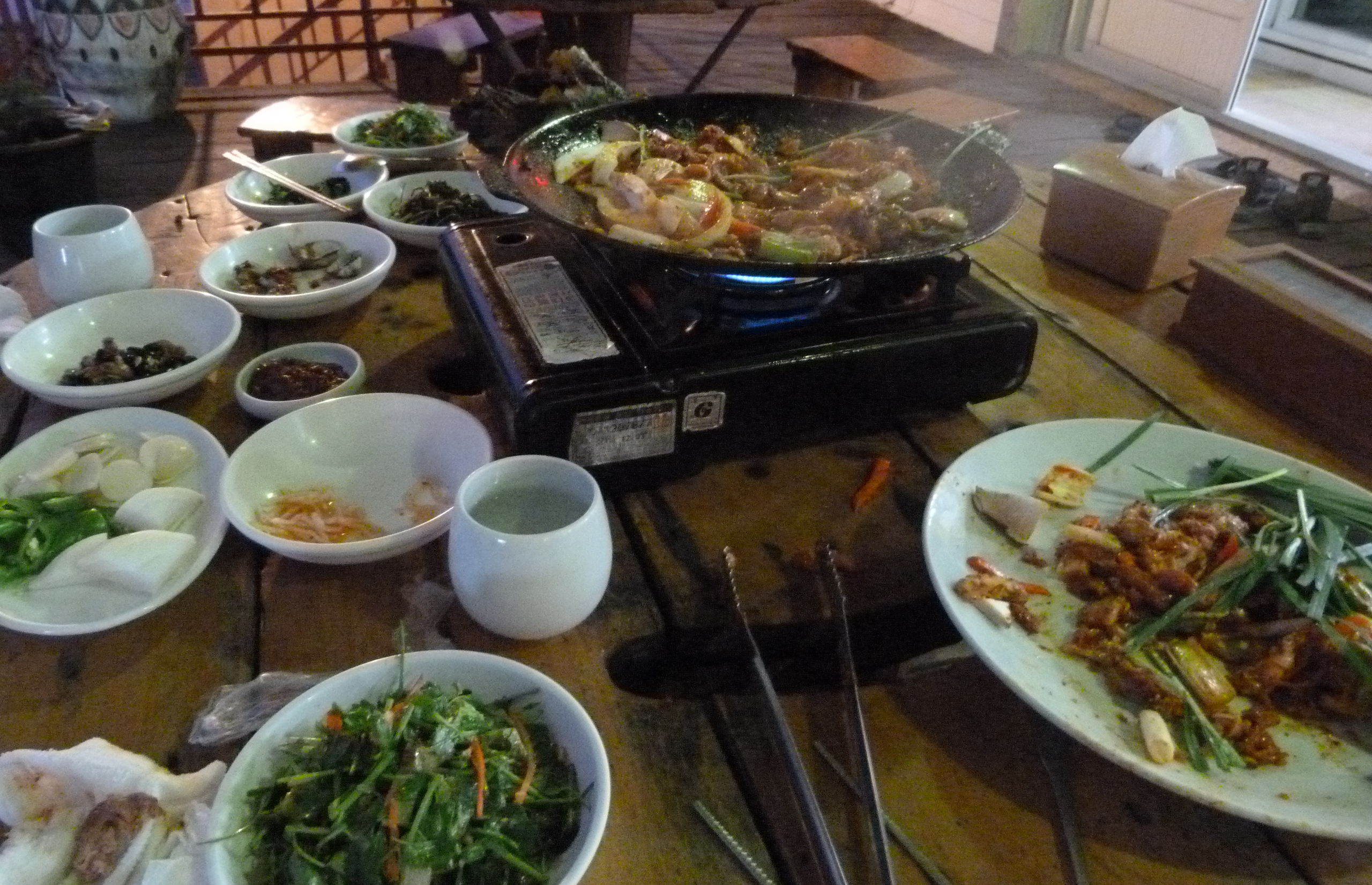
Duck and pheasant seem to be the local speciality and we ended up having dinner that evening at a duck restaurant which hadn’t been open long. We were the only customers and were given a present of a toothbrush set each.

Next morning it was easy enough to flag a taxi down and get ourselves to the bus terminal for the journey to Pohang. We’ll probably look to stay in Palgongsan again when the World Athletics Championships take place in Daegu in September and combine another of the peaks with a trip to see Usain Bolt.